
[INQ. NO. 2504E04] CryptoLab, Inc. is a global leader in encrypted computing, pioneering advancements in Fully Homomorphic Encryption (FHE) and Post-Quantum Cryptography (PQC) to enable secure, privacy-preserving, and quantum-resistant data processing.
With a portfolio of over 70 patents, including the groundbreaking CKKS scheme, CryptoLab continues to redefine the frontier of cybersecurity and data privacy. Its team brings together world-class experts from both academia and industry, with deep specialization in cryptography, security, AI, data science, and computer science.
Headquartered in Seoul, CryptoLab also maintains strategic subsidiaries in Lyon, France, and San Jose, California, supporting its mission to make encrypted computation globally accessible.
Encrypted Facial Recognition (EFR)
Traditional facial recognition systems are vulnerable to data breaches because facial matching is performed in plaintext.
At first glance, reconstructing a facial image from facial landmark data—commonly referred to as a facial template—may seem improbable due to its numerical vector format. However, recent advances have made it increasingly feasible to reverse-engineer facial templates into facial images.
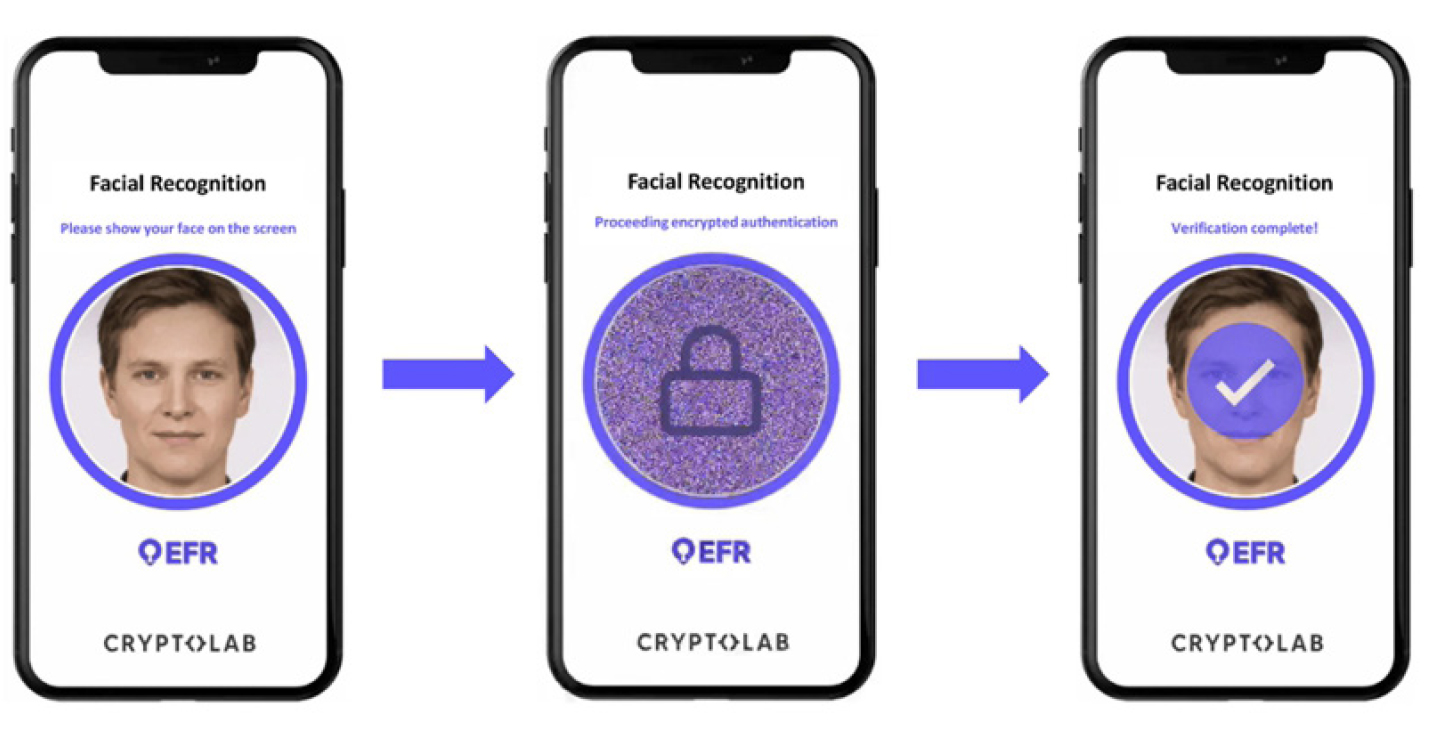
To effectively protect facial templates, it is crucial to secure not only the database where they are stored, but also the face matching process itself. EFR, powered by CryptoLab’s fast and secure FHE (Fully Homomorphic Encryption), keeps facial data encrypted at all times.
EFR is immune to data breaches, side-channel attacks, supply chain risks, insider threats, and a range of other cyber and privacy threats, because the data is always encrypted—even while being computed upon. As such, EFR databases and computations can be securely hosted on off-premise infrastructure.
EFR performs encrypted facial recognition in a fraction of a second against tens of millions of encrypted face template vectors with GPU acceleration. Additionally, EFR maintains performance with additional GPUs—estimated at 1 to 2 GPUs per million face templates—while achieving computation accuracy comparable to plaintext facial recognition results.
In addition, EFR provides quantum-resistant data protection, as CKKS is based on lattice cryptography, like NIST’s ML-KEM and ML-DSA.
korean-electronics.com | Blog Magazine of korean electronics, brands and Goods



 Korean-Electronics.com
Leave a comment