Mobile Video Emerges as Killer Service on Adoption of LTE-A

Long Term Evolution Advanced (LTE-A), the latest telecommunications technology that enables users to download a movie in 43 seconds, has heralded a new trend where people turn to mobile devices to watch videos. People often wear earphones and watch videos on their smartphones in a bus or subway trains during commuting time. With the adoption of LTE-A, a communications standard which offers access to the Internet at a pace twice faster than that of the 4G LTE, mobile video services are emerging as a “killer” service. Videos accounted for over 51 percent of global mobile data traffic last year, and their share is estimated to reach 66.5 percent four years later, according to the world’s largest networking equipment company Cisco. Videos accounted for 64 percent of mobile data traffic in South Korea at present, and the their share is forecast to jump to 74 percent four years later, far higher than the global average. A surging number of people watch TV and do searches on smartphones or tablet PCs simultaneously.
The nation’s mobile video contents market is burgeoning in line with the latest trend. Tving, CJ HelloVision’s mobile app that broadcasts TV programs on a real-time basis and provides video-on-demand (VOD), has attracted a total of over five million subscribers last month. Meanwhile, Hyundai HCN and Pandora TV jointly launched an N-Screen service called “Everyon TV,” which allows subscribers to view purchased contents on any device including smart devices and PCs without interruption. The N-Screen app logged a total of 2.6 million downloads and 100,000 unique visits per day.


By Kim Min-su : Here
LG Unveils World’s First Curved OLED TV in US

LG Electronics has recently released organic lightemitting diode(OLED) TVs with curved displays in the
US.

The South Korean tech giant rolled out the revolutionary model with a 55-inch curved screen for the first time in the world on its home turf. Usually, images on a flat screen are stretched to match the screen size, making it possible for them to be distorted.

However, a curved display helps eliminate such a problem, as it is designed to make the images match their standard dimensions. The curved display also provides a more life-like experience when watching programs.


By Kim Min-su : Here

S. Korean Chipmakers Dominate DRAM Market

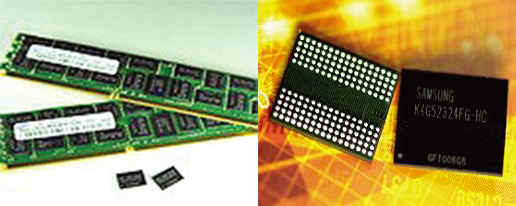
South Korea’s chipmakers Samsung Electronics and SK hynix led the global market for mobile DRAM used in mobile devices in the first half (H1) of this year, data showed.

Samsung Electronics shipped 1.1 billion units in the first quarter (Q1) on the basis of 1 Gb mobile DRAMs, according to a market research firm iSuppli Sunday. Samsung owned the highest market share of 49.7 percent in the global DRAM market.

Meanwhile, SK hynic held the second highest of 23 percent with the shipment of 544 million units. The combined market share of Samsung Electronics and SK hynix reached 72.7 percent, meaning seven out of 10 mobile DRMAs are manufactured by Korean chip makers.

Japan’s Elpida ranked third spot with the shipment of 519 million units (22.0 percent), followed by the US’ Micron Technology with 176 million units (4.5 percent). The global mobile DRAM shipment reached 2.3 billion units. Mobile DRAM shipment took up 29 percent out of the total DRAM shipment in Q1.

By company, Samsung Electronics took up the highest 42 percent of the global mobile DRAM shipment, followed by SK hynix with 24 percent and Elpida with 35 percent. iSuppli forecast the mobile DRAM share should grow from 34 percent this year, 41 percent in 2014 and 43 percent in 2015, surpassing that of DDR3 DRAM for PC use by 2015.

The globla mobile DRAM market is estimated at $8.1 billion this year, up 10.5 percent from a year ago ($7.4 billion).


By Kim Min-su : Here

Samsung to Spend $1.3bn on Future Technology

The Samsung Group recently announced its plan that it will establish a new foundation in which it will invest 1.5trillion won($1.3billion) over the next decade from this year as a way of fostering future science technology. The new foundation, to be set up this month, will implement three programs dedicated to fostering future technology in line with current administration’s the so-called “creative economy” agenda.

 
The three programs include: 1) producing Nobel science prize winners in the fields of basic science(physics, chemistry, life science and math); 2) promoting materials technology; and 3) supporting the convergence of information and communication technology(ICT) industry.

 
“Abundant human resources and high technology are the only assets that Korea can rely on for future growth. Thus, in order to grow into an advanced country, it is vital to continue our investment in basic science, a foundation of innovative technology, such as materials technology and ICT convergence,” said Samsung, adding “Our aim is to produce Nobel science winners and inject new vitality into the science and technology industry by offering research support for the four fields of basic science without any red tape.”

 
In the first phase, Samsung will select 100 to 200 projects for college faculty, state think-tanks and researchers at mid-to small enterprises, providing 250 billion won for each program, a total of 750billion won over the next five years.

 
In its later phase, Samsung will provide financial assistance based on feasibility evaluation and research outcome. The research in basic science will be offered up to 10-year support while that in ICT convergence and materials technology will receive assistance for commercialization. The foundation will announce the program list upon the completing of its construction in June. And it will accept projects by July and select them in October to begin full-fledged support in November.


By Kim Min-su : Here

Global Sales of Ultra HD TVs Forecast to Surge 10-fold to 10mm Units in 2016

Ultra high definitions(UHD)TVs, which offer picture quality four times superior than full HD TVs, are forecast to gain a larger market share faster than previously expected. Global sales of UHD TVs are estimated to reach 930,000units this this year, according to a report for the first quarter(Q1) released by market research firm DisplaySearch.

 
The sales would rapidly surge to 3.90million units in 2014 to 6.88million units in 2015 to 9.87 million units in 2016, 10 times larger than the estimated sales for this year, predicted Display Search in the report. In the report for Q2 last year, the research firm had estimated global sales of UHD TVs would number 90,000units this year, 700,000units in 2014, 2.24million units in 2015, and 4.01million units in 2016.

 
Annual sales estimates have soared two-fold to 10-fold in less than a year. The estimates have been revised upward based on the concurrence of major tech companies’ aggressive activities in developing and launching UHD TVs.

 
South Korea’s leading tech company LG Electronics unveiled the world’s first 84-inch UHD TV in August last year, but the TV industry believed it was too premature because no contents had been produced for UHD resolution. But the industry has rapidly changed its perception since the launch. The nation’s largest tech giant Samsung Electronics released 85-inch UHD TV in January this year, while Sony unveiled 55-inch and 65-inch UHD TVs recent month.

 
China-based Seiki recently began selling its UHD TVs at a very cheaper price. LG Electronics is working on launching 55-inch and 65-inch models, and Samsung Electronics plans to expand its UHD TV portfolio to add both affordable and premium models.


By Kim Min-su : here

DRAM Prices Grow Rapidly

dpgr1Fixed prices of dynamic random access memory(DRAM) chips have grown at the most rapid pace this year.

Market research firm DRAMeXchange set a fixed price of DDR32 gigabits(Gb) 256Mx8 1333MHz chip at $1.28 in the fixed half(H1) of March this year, said sources in the semiconductor industry. The price jumped 18.52 percent from $1.08 in the H2 of February, and is the highest since $1.31of early August in 2011.

The DRAM price fell to a record-low $0.80 in late November last year, but swung to modest growth since late last year. The price growth accelerated since the beginning of this year.

DRAM prices are rising, backed by the industry’s forecast that semiconductor manufacturers are cutting production, which will lead to a shortage of supply. In other words, major DRAM makers including Samsung Electronics and SK Hynix are reducing the production of DRAM for PCs, so PC manufacturers are stockpiling DRAM in case its supply runs low.

DRAM prices are rising, backed by the industry’s forecast that semiconductor manufacturers are cutting production, which will lead to a shortage of supply. In other words, major DRAM makers including Samsung Electronics and SK Hynix are reducing the production of DRAM for PCs, so PC manufacturers are stockpiling DRAM in case its supply runs low.

Meanwhile, prices of NAND flash that are embedded in smartphones continued to rise. The fixed price of 64Gb 8Gx8 MLC jumped 6.80 percent to $5.34 from that of late February, and the fixed price of 32Gb 4Gx8MLC also rose 9.51 percent to $2.88.

If you want more information, please contact us.
Korean-electronics.com | Blog Magazine of Korean electronics, brands, and goods

S. Korea’s Exports, Imports Shrink in February

201304M_5

South Korea’s exports fell to the lowest level in 13 months last year, with imports sliding to the lowest level in two years. According to the customsclearance trade figures provided by the Korea Customs Service(KCS), the nation’s exports shrank 8.6 percent on-year to $42.34 billion in February. Imports also faltered 10.6 percent to $40.31billion.

Korea continued a trade surplus for 13 straight months, sealing $2.02billion, up 66.4 percent from a year ago.

By product, exports of major industry products such as shipbuilding(-42.2 percent), automobiles(-15.6percent), iron and steel(-10.6 percent), auto parts(-4.2 percent) and petroleum products(-1.7 percent)contracted, excluding liquid crystal devices(6.3 percent), wireless communication devices(2.7 percent), semiconductors(1.1 percent).

By region, exports bound for the US shrank 11.4 percent, while those for Japan, the EU and China also fell 17.4 percent, 15.4 percent and 1 percent, respectively.
Meanwhile, the nation’s cumulative exports during the first two months of this year totaled $88 billion, and imports reached $85.5 billion, leading to a cumulative trade surplus of $2.5 billion, the data showed.

If you want more information, please contact us.
Korean-electronics.com | Blog Magazine of Korean electronics, brands, and goods

Samsung keeps US market leadership even after iPhone 5 launch

This image from www.samsung.co.kr

This image from http://www.samsung.co.kr

South Korea’s Samsung Electronics has maintained its market leadership in the US even after Apple launched the iPhone 5. Samsung’s lead in the US smartphone market increased 1.2 percentage points for a controlling 26.9 percent share. Apple’s smartphone market share grew from 17.1 percent to 18.5 percent, gaining 1.4 points following the launch of the iPhone 5.

Rounding out the top-five were LG, Motorola and HTC, all of which saw their market shares decrease from August. LG fell 0.7 percentage points to 17.5 percent, Motorola dropped 0.8 percentage points to 10.4 percent and HTC’s market share decreased from 6.3 percent to 5.9 percent.

comScore, a research firm, said that a majority of devices, 53.7 percent, were powered by Google’s Android operating system, which saw growth of 1.1 percentage points. Apple’s iOS market share increased 0.7 percentage points to 35 percent.

RIM’s BlackBerry platform ranked third with a 7.3 percent share, down from 8.3 percent in August, and Microsoft’s operating system dropped 0.6 percentage points to a three percent share of the market. It was followed by Nokia’s Symbian with a 0.5 percent share. The survey involved about 30,000 mobile phone subscribers aged over 13 in the US.

If you want more information, please contact us.
Korean-electronics.com | Blog Magazine of Korean electronics, brands, and goods

Slow recovery in shipbuilding, petrochemical and steelmaking

ShipbuildingSouth Korea’s shipbuilding, petrochemical and steel manufacturers will continue to suffer from slow recovery due to a global supply excess and low demand in the second half(H1) of this year, according to a report released by KDB.
The report stressed local shipbuilding and display industry will show a high growth figure due to the base effect, but actual recovery will be insignificant. Mobile phones will continue to be strong but relocation of production sites to overseas will contract domestic production and export. Meanwhile, automobile and semiconductor sectors will perform well in both shipments and exports.


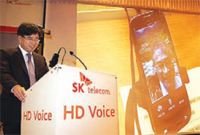
SKT to launch world’s first VoLTE service by September this year


SKT to launch world's first VoLTE serviceSouth Korea’s leading mobile carrier SK Telecom (SKT) is set to launch the voice-over-LTE (VoLTE) service, which offers clearer voice quality, at the same rate as the service using the third-generation (3G) network.
The VoLTE service is a voice call service that utilizes fourth-generation(4G) LTE networks. LTE service subscribers have used mobile data services through the LTE network, but phone call services have been provided through 3G networks so far.

The VoLTE service boasts sound quality twice as clearer than the 3G services, and the service will deliver subscribers’ voices close to the original sound on the phones. SKT’s video phone calls will also offer superior definition, clearer by 12 times than those offered through 3G networks, and connection time for phone calls will be reduced by over 20 times (0.3 seconds minimum).

Charges for the HD Voice services are expected to be set at 1.8 won($0.0016) per second, which is the same rate as the charges applied to the 3G services.

“SKT plans to set charges for premium-class HD Voice services at the similar level to the current charges applied to the 3G services as an effort to introduce the services to more subscribers,” a high-ranking SKT official said.

The VoLTE service will be available with smartphones that have LTE functions. Samsung Electroncis’ Galaxy S3 LTE is compatible with the VoLTE service, and LG Electronics and Pantec will also launch VoLTE smartphones.

All three S. Korean mobile carriers will be offering VoLTE services to subscribers by the fourth quarter (Q4) this year. LG Uplus and KT will launch VoLTE services at the end of September and October, respectively.

If you want more information, please contact us.
Korean-electronics.com | Blog Magazine of Korean electronics, brands, and goods