Increasing demand for products with high efficiency and light weight promotes the development of products using advanced materials, though the existing processing system cannot catch up with it due to its limitation in applying it to mass production. For this reason, both development of material reflecting characteristics of products and process technology and development of a package production system for high-quality processing of advanced materials developed by it are indispensable. Now, let’s take a look at the trend of developing the advance material processing systems and the plan to develop core technology in the advanced materials manufacturing systems. In addition, we will explore details of core development in the advanced materials manufacturing systems – development of carbon fiber reinforced plastic, development of Jig center horizontal 5-Axis processing system, and development of the Sapphire processing system.
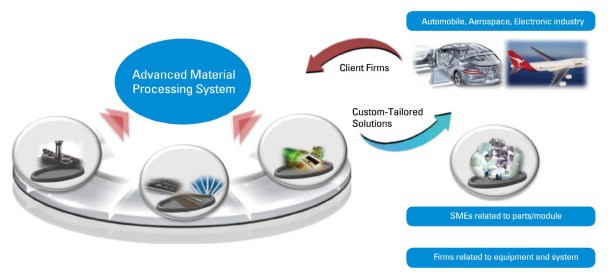
Summary of Advanced Material Process System
Changes in industrial environment
Advanced materials manufacturing system stands for a package production system converging equipment, process technology, and ICT in order to secure high quality and productivity after processing advanced material parts (carbon fiber reinforced plastic, titanium, and sapphire) whose characteristics of ultra-light weight and high strength present difficulties in machine processing There is an increasing need to develop an advanced materials manufacturing system owing to changes in the industrial environment. First, the industrial environment is in a transitional stage, those advanced countries are fortifying environmental regulations, while unstable international oil prices are pushing up demand for high-efficiency and lightweight products. Since 2014, Europe has started to conduct EURO-6 to all the imported automobiles which specifies application of the same environmental regulations as to their domestic products. If applying the less than 130g/km of the exhaust gas regulation standard in EURO-6 to our export automobiles based on 2011 statistics, only 7 models of small cars out of the total of export automobiles (big models are impossible to export) can pass that regulation. It shows how much critical it is to develop a high efficient and light weight automobile. U.S.A also keeps heightening the standard of CAFÉ (Corporate Average Fuel Economy) and
determined in 2012 to push up the fuel economy standard on vehicles and light trucks to 54.5MPG, double in current average fuel economy by 2025.
Changes in products and materials
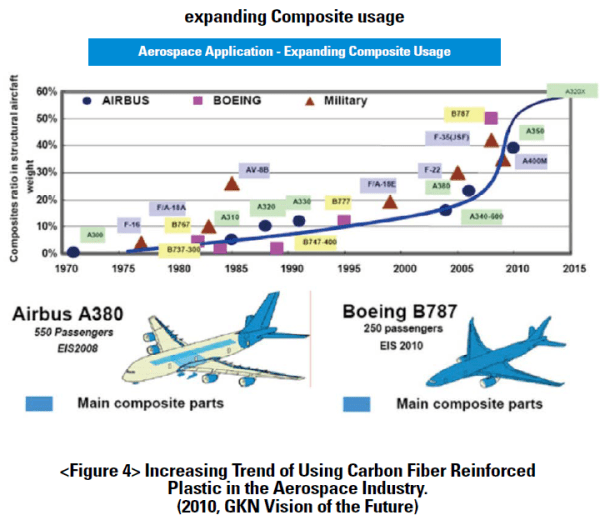
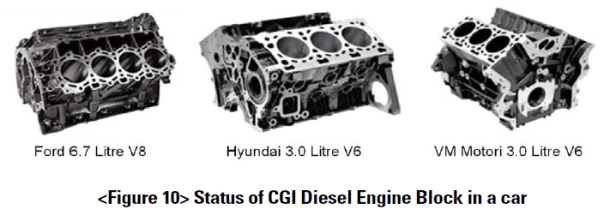
In order to respond to these changes (higher environmental regulation and fuel economy), global manufacturers are carrying out a survival strategy to make much lighter parts and products. A representative light weight material, carbon fiber reinforced plastic, is in drastically increasing demand from aircraft, automobile, and other fields, which is sensitive to energy efficiency due to its light weight but rigid and corrosion resistance, expanding its application to shipping building, high-speed railway, and new industry like recycling energy field. For example in the aerospace industry, the fuel economy of the Boeing 787 Dreamliner was improved by 20% by replacing 50% of its airframe with carbon fiber and Airbus A380 adopted advanced material for 40% of its airframe for improved fuel economy. And in the automobile industry, advanced global auto-makers like Mercedes-Benz, BMW, Ford, and Audi are carrying out fuel economy through engine downsizing by applying CGI material to their engines for fuel economy improvement and light weight, while application of carbon fiber reinforced plastic is expanding to their interior and exterior parts (body, seat, and etc.).
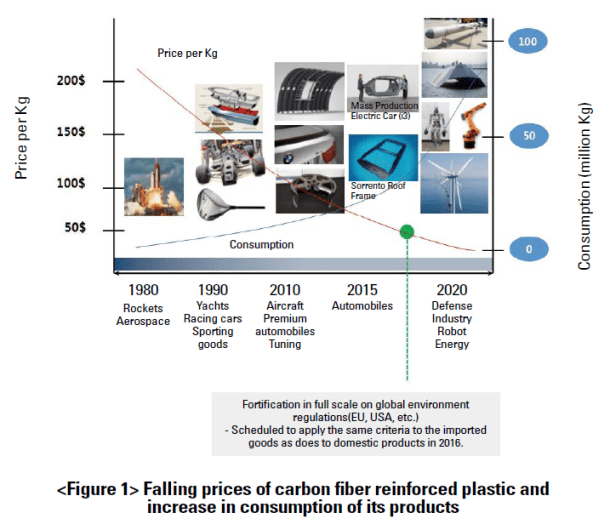
Accordingly, material firms are increasing their investment in their large-scale production facilities together with the development of material production technology to catch up with the drastically increasing application of advanced materials such as carbon fiber reinforced plastic, titanium and so forth to lightweighted parts and products. For carbon fiber reinforced plastic, investment by material firms like Hyosung and Taekwang on production facilities for carbon fiber has begun in full swing since 2013, production of advanced materials is now available ─ 2,000 tons by Hyosung, 4,500 tons by Taekwang co., ltd., and 2,200 tons by Toray, especially, Hyosung has a plan to invest KRW1.2 trillion won for carbon fiber production at Jeonju by 2020. Developed production technology and expanded application, once applied to a few of particular industries (spaceship and military aircraft), resulted in increased production with lowered price, which would facilitate its application to various fields of industries including common product market that has difficulty in adopting it owing to expensive price. For carbon fiber reinforced plastic, the price of carbon fiber reinforced plastic has been dropped to US$50.00 per kg in 2014 from US$ 200.00 level in 1908s caused by increased global production of its raw material – carbon fiber to 140,545 tons in 2014 from 111,785 tons in 2012 (see figure 1), for titanium alloy, the range of applicable items has been widened more broadly by fallen price of material to US$35.00 per kg in 2011 from US$45.00 in 2009 thanks to developed technology in material production.
Need for development
Even though usages of advanced materials are increasing in various industries such as in aerospace, automobile, and energy, existing technology has limitations in processing them. Accordingly, demand is getting higher for a new processing technology and a processing system optimized to process these advanced materials, which would be a new opportunity for domestic processing system industry. In the past when utilizing advanced materials had been limited only to rockets and aerospace industry, it was possible to meet small market demand by using high-priced specialized equipment, but expanding usage of the advanced materials to industries whose demand is large like automobiles and mobile phones requires new production systems for their mass production.
For this, the Machine Tool Manufacturing Association in Europe encourages its members for technology development upon recognizing the advanced material processing technology as a momentum for their future growth, expanding application of parts with advanced materials to new models of airplanes in those global aerospace companies like Boeing and Airbus boosts demand for processing systems that can provide high quality and high productivity. Oversea advanced machine tool manufacturers are entering the aerospace industry market by commercializing a new process applied processing system for the advanced material, and a multi axis specialized equipment, while carrying out a strategy to supply a package system like an equipment – process – operation solution not a unit processing equipment in order to comply with the manufacturing line in the aerospace parts industry.
Developed technology in material field has enabled localization of carbon fiber plastic, super strength steel sheet in domestic market and products made by big business groups with competitive edge have been introduced in the global market and expanding its shares, but due to lack of technology in the advanced materials manufacturing system based on the process technology considering characteristics of material and product, those advanced machine tool manufacturers overseas still take a big portion of its market share. From now on, under the situation expecting a great growth in the advanced material parts market, it is imperative to develop core technology in the advanced materials manufacturing system and its systemization technology.
Trend in Development and marker Perspective of
Advanced materials manufacturing system
Products of carbon fiber reinforced plastic and its market perspective
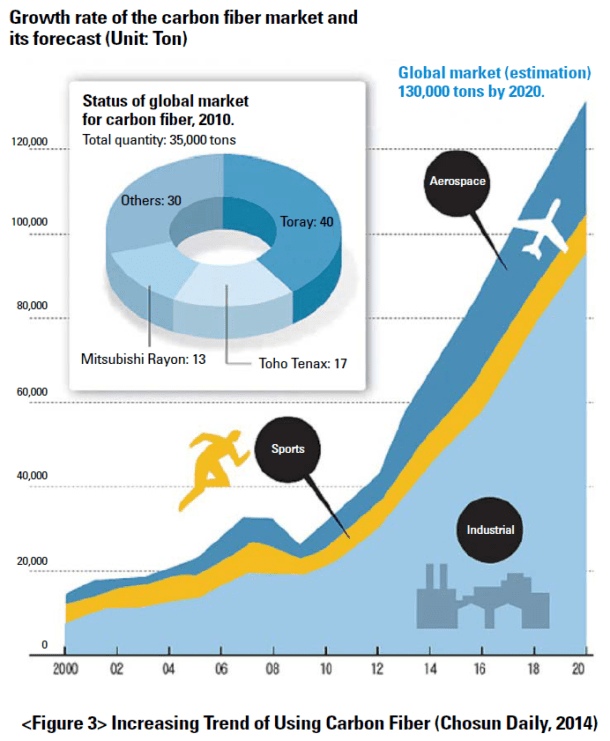
Demand for carbon fiber reinforced plastic shows a rapid increase thanks to increased demand for higher efficient and light weight parts <Figure 3>.. For the aerospace industry – the biggest single market among them, the global market including both civilian aircraft and military aircraft amounted to US$D180.2
billion in 2010, and is expected to grow by 3.8% of annual average and to reach US$248.5billion by 2020. Carbon fiber reinforced plastic is being used in most parts of fuselage for recently developed aircraft, which comprises 30 ~ 60% of the total weight of an aircraft <Figure 4>.
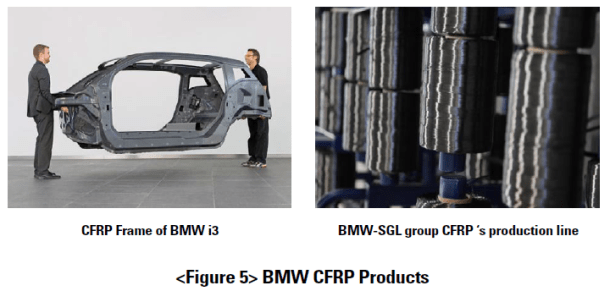
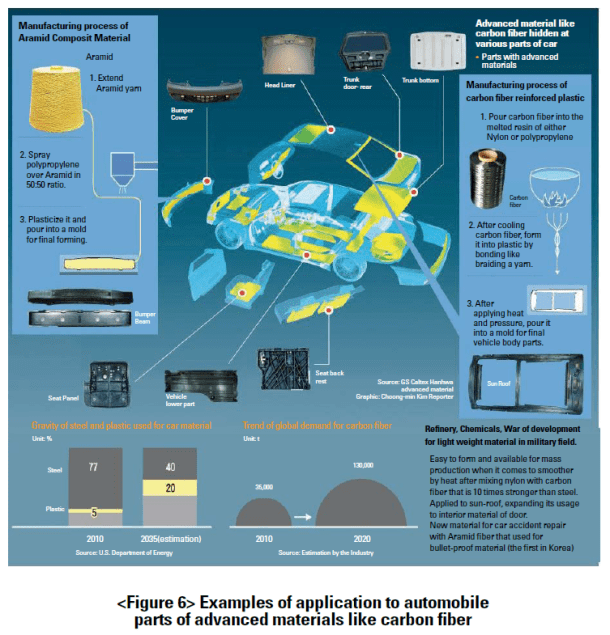
Recently, the automobile industry also increased the use of carbon fiber reinforced plastic for light weighted body in order to obtain fuel economy high efficiency and to reduce greenhouse gas. BMW is leading this trend by applying carbon fiber reinforced plastic to their various parts like automobile frame and has applied carbon fiber reinforced plastic to their new electric car i3, i8, and is planning to us it for their common mass production cars like 7-series within 1 ~ 2 years <Figure 5>. For this, BMW has invested US$200 million to SGL – a carbon fiber reinforced plastic producer to expand its production capability of annual 3,000 tons of carbon fiber. Mercedes –Benz already applied carbon fiber reinforced plastic to their SL series since 2012 aiming at the 10 % lighter cars in their all models by concluding a contract with Toray, a Japanese carbon fiber producer, and is now carrying out their plan for light- weighted car by applying carbon fiber reinforced plastic to body panel and suspension parts of new model E-class by the end of 2015. In Korea, it has been applied to sunroof of KIA’s “All New Sorrento’ and to Hyundai Automobile’s next generation Hydrogen Fuel Cell Concept Car ‘Intrado.’ In near future, application of advanced material like carbon fiber reinforced plastic is expected to expand to various parts of automobile <Figure 5>.
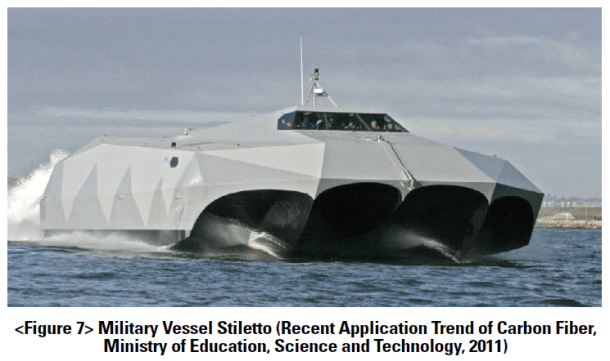
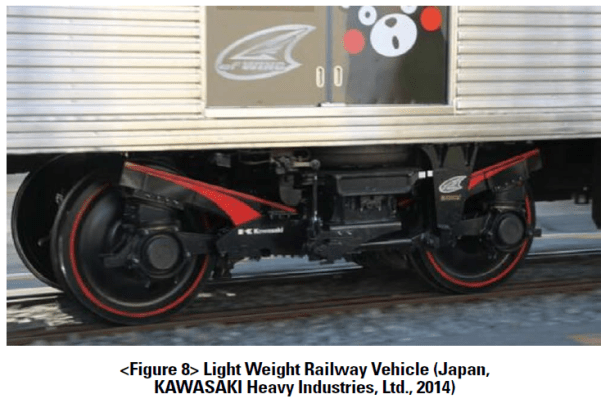
Shipping and railway industries also show increasing trend of using carbon fiber reinforced plastic in order to improve for light weight and corrosion resistance characteristics by adopting carbon fiber to vessel frame and structures. Worth to note is that, a large carbon fiver vessel Stiletto has been developed with stealth function, which applies excellent electromagnetic Shielding effect of carbon fiber to a military vessel. Japanese railway industry has developed a 650 Kg class bogie lighter by 40% than existing one by saving 450Kg with carbon fiber reinforced plastic for their lightweight movement in line with simplified structure of steel material <Figure 8>.
Advanced Metal Material Products and its Market Perspectives
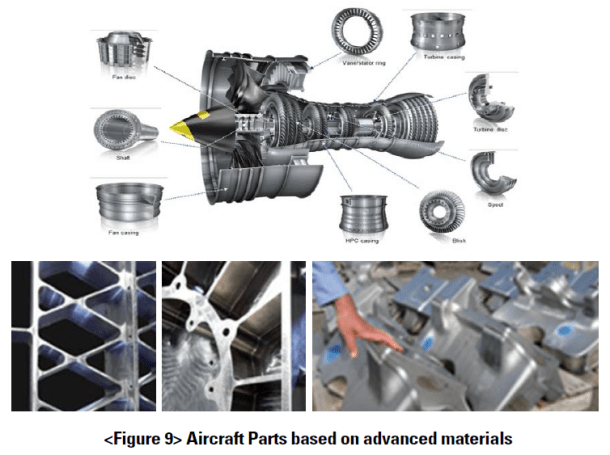
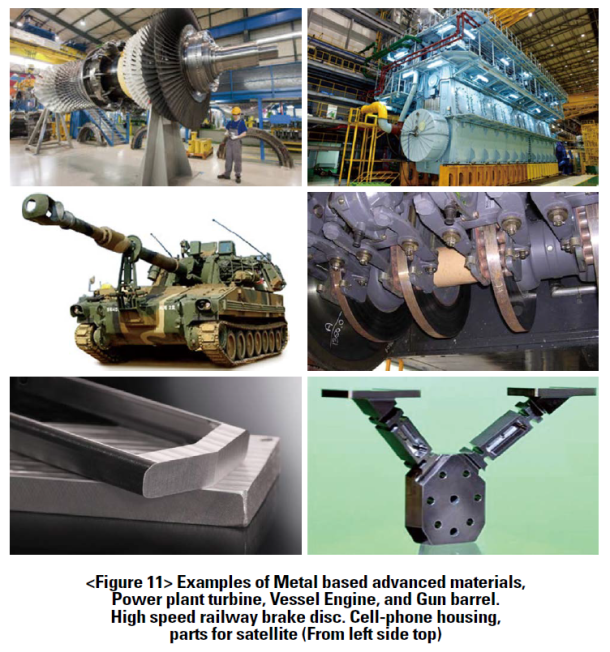
Advanced metal materials are being utilized in advanced industry fields such as munitions, aerospace, energy, and nuclear power field for its high functionality. Its application fields are rapidly expanding to automobile, aircraft, and high speed railway field caused by energy depletion and global environmental issues, and recently it started to get highlighted as a case for personal IT device.
Advanced metal material spreads out its application in high speed thanks to increasing demand and lowered price caused by increased production quantity, and its market is expected to grow rapidly; global market for major products is estimated at around US$95.6billion in 2020 with 10% of annual growth from US$437billion in2012. In automobile field, it widens its usage by showing high annual average growth rates like 12.7% of growth in CGI engine market and 11.8% in light weight metal composite market according to trends of fuel economy improvement and environment-friendly product. In aerospace field, its market would increase to US$17.46 billion for turbine and US$7.49 billion for titanium parts in 2020 comparing from US$3.33 billion and US$4.66 billion respectively. The energy related parts would show a sharp growth with annual 16.9% in average to US$915 million in 2020 from US$235 million in 2012 thanks to demand for power plant and new recycling energy (Import & Export Data by Korean Industry, U.S. Gardner’s statistics, 2012).
Sapphire Products and Its Market Perspectives
Demand and interest are increasing on sapphire cover glass substitutable for existing cover glass due to high quality/high functionality of smart mobile device, developing Internet of Things (IoT), and expanding security issues in mobile device. Cover glass market shown a high speed growth together with expanded mobile device for past several years is expected to slow down its growth rate from the peak in 2014, which is considered to have been attributed to the matured and saturated market for of its major application devices and overheated supplying competition.
According to IHS Display Search, the cover glass market for display in 2014 showed 17% growth rate comparing with that in the last year, which is only a one half level attained at 37% between 2012 ~ 2013 . The growth rate is estimated to keep going down and fall drastically to the 3% level in 2018. Meantime, the cover glass market adopting sapphire is foreseen to expand, especially smartphones with higher specification and wearable device area would first adopt sapphire for their cover glass.
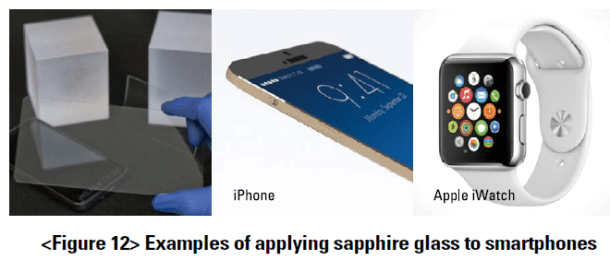
Expansion of using sapphire material would be subject to the cover glass market, smartphone makers are adopting sapphire to their camera lens and fingerprint recognition module. Sapphire cover glass with infrared transmissible, higher light transmission coefficient, and higher surface hardness than the reinforced glass is expected to be applied to the Internet of Things and security related mobile devices by utilizing it broadly for motion recognition and biometrics. If Sapphire cover glass overcomes its weak point, 10 times more expensive than existing reinforced glass for difficulty in processing and lower yield, it would be used widely as replacement material for reinforced glass. Furthermore, smartphone makers and manufacturers of both sapphire materials and its panels are reinforcing their strategic cooperative relationships to heighten its yield and to reduce production cost. Apple, the most actively involving into sapphire glass, seems to apply it their next smart phone and smart watch, obtaining offensively those related patents and organizing the related supply chain. HUAWEI, a Chinese smartphone maker is planning to adopt sapphire glass to their new premium smart phone to be released soon and is known to contact with sapphire glass manufacturers like Rubicon. Besides HUAWEI, Chinese maker VIVO and XIAOMI, Taiwan HTC are also considering to mount sapphire glass on their smartphone screens.
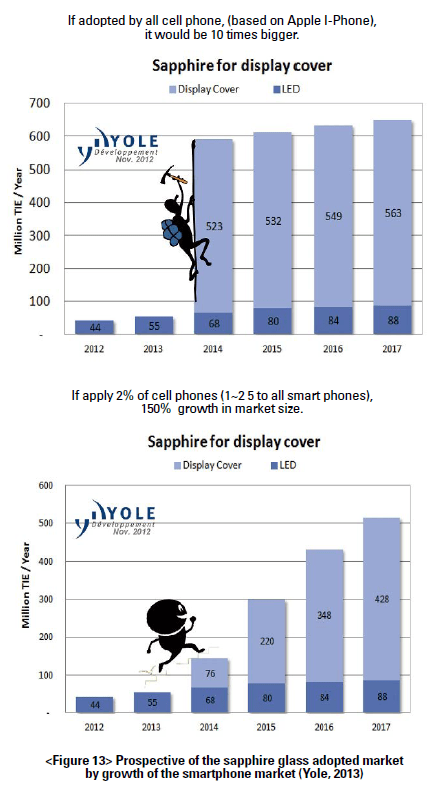
Development and growth of sapphire cover glass market is expected to be a new driving force that leads growth of sapphire related industry having been dependent on light source for display and LED for common lightings. According to Yole Report in 2012, global LED market is estimated to grow gradually US$14.3 billion in 2014, US$17 billion by 2017 from US$10 billion level in 2010 as a common lighting market.
Emergence of sapphire glass for display cover in the sapphire material and its panel industry is considered as a new turning point to reorganize the existing industrial structure, and particularly, U.S. Apple plans to take an upper hand in this market by securing a production platform for sapphire glass through US$600 billion worth investment at the end of 2013 which would apply sapphire cover glass to their smart phones and smart watches. In future, the sapphire glass market just for Apple alone is estimated to be KRW 2 trillion (Yole, 2013) and if it includes the total smartphone market, it would be KRW 20 trillion.
Trend in Development of Processing System and its
Market Perspective
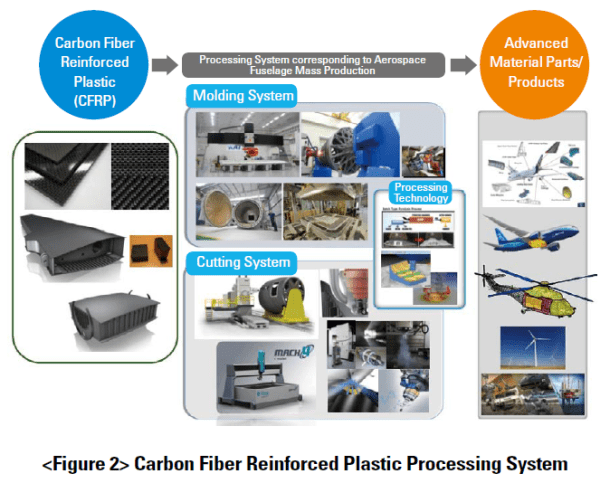
Along with growth of the advanced material market, the processing equipment market to produce them also grows. The carbon fiber reinforced plastic market can be divided roughly into the aircraft fuselage manufacturing system market and the molding and cutting system market, and it is estimated to maintain annual 15% of growth to reach approximately US$ 63.5 billion in 2020.
Especially, the aircraft fuselage market shows more than 10 % growth annually while the carbon fiber reinforced plastic market marks 11% of growth rate on annual average. Carbon fiber reinforced plastic has lighter weight and higher strength than metal, however, shows severe delamination phenomena between stacked layers when processing, which results in big differences in requirements of processing equipment from that of metal processing equipment for structural strength and cutting power of machine tool. For these differences, machine tool manufacturers are releasing their products in a different field from common machine tool manufacturers are doing. Under the situation that the carbon fiber reinforced plastic market keeps growing and demand for new equipment is expanding as modification of existing processing systems mainly for metal to the system for advanced materials is required.
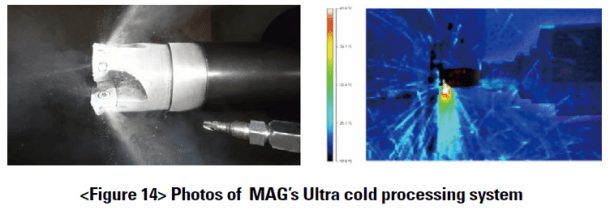
Global machine tool manufacturers already commercialized the specialized processing equipment in order to meet the requirements of higher value added manufacturing industry like aerospace and automobile or are fortifying their responding capability through steady technology development to meet the need of the industries whose demands are increasing rapidly. Germany MAG has developed the Turning Center and Milling System with ultra cold processing applied to advanced materials for the first in the world and now supplying their products exclusively Airbus, Boeing, and Lockheed Martin, and America’s 5ME has developed a cryogenic cooling liquid nitrogen machining module by using the storage, supply, flow control system for cryogenic cooling and hollow spindles and hollow tools and is responding to the demanding industries together with MAG.
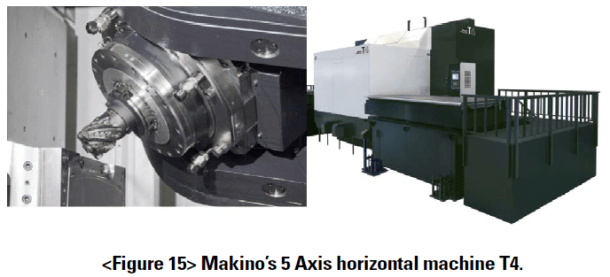
A Swedish firm, NOVATOR in cooperation with Boeing and Sandvik Coromant has developed an orbital type drilling equipment to process carbon fiber reinforced plastic and CFRP + Metal stack and applied it to aircraft mass production. Makino in Japan released the 5 axis horizontal machine T2 and T4 to process large CFRP structure for an aircraft.
This equipment adopted appropriate machine structure and additional devices to processing advanced materials, like attaching a process monitoring sensor to the spindle in order to attenuate vibration by an active control over the guide friction force through automatic change in the processing conditions if there is excessive amount of cut portion.
DMG MORI, A partnership company between Japan and Germany, carried out trimming and drilling by using ultra sonic process with ultrasonic machining tool for processing advanced materials (metal materials and carbon fiber reinforced plastic). Belotti, an Italian company producing mainly a 5-axis machining center and water-jet cutting equipment, is now producing specialized equipment for processing CFRP parts of automobiles and auto-bicycles, and MULTIAX, Breton, an Italian CNC manufacturer, produced CNC machine for processing CFRP, FRP.
Besides of them, several machine tool makers (Kennametal Inc., Sandvik Coromant, LMT tools) are supplying special machining tools for processing CFRP and other composite materials. At the technological cooperation level, strategic cooperation systems between global companies expanding to reinforced responding capability to the demand of related industries and to maintain market control power. DMG (Germany) and MoriSeiki (Japan) are carrying out both technology development and marketing simultaneously after merging into DMG MORI to make a joint response to various system line up and global market, and eight companies in alliance with each other such as BLOHM, EWAG, JUNG of the KORBER SCHLEIFRING Group are supplying grinding systems. Also, equipment – system producers and parts module specialized makers are saving burdens of fundamental
technology development and securing credibility of their products by building up cooperative relationship with each other. An equipment producer like Mazak are cooperating with specialized CNC control companies such as Fanuc, Mitsubishi, and Siemens, while automation and operation solution (SW) suppliers are carrying out to build a business model that supplies a package system to the request of a demanding firm in cooperation with equipment-system producers. For example, operation solution suppliers like Rockwell Automation by combining their operation system to cutting processing technology of DMG MORI are supplying an optimized processing system of milling, drilling and grinding mainly Inconel, Waspalloy, Rene, Nimonic, Hastelloy among nickel alloys.
Development of a tool is important for high strength material processing, though various coatings such as TiN, Al2O3,TiAlN, TiN, TiC are being applied in order to overcome weak points in existing ultra light tool such as fast wearing out and lower processing speed. Recently, research and development are under way on coating tool with various new materials having higher antioxidation, higher temperature, higher hardness, and higher surface lubricity by using the coating method based on physical vapor deposition technology. For ceramic wire sewing machine, Japanese companies are almost monopolizing its markets and have developed various forms of wire sewing machines with production systems. Komatsu NTC in Japan commercialized the ingot tilting type wire sewing machine after having secured its stability, and is continuing their R&D in order to maximize credibility and utilization of their equipment like a sensor to detect disconnection of wires, and Jig to measure location of the processed objects and wires.
The lap grinding related equipment markets are almost monopolized by Stahli in Swiss and SpeedFam, NTC, Disco in Japan. Domestic equipment can not enter this market for lower credibility, which requires development of equipment and application of mass production.
In Switzerland, HCTShaping Systems, N. BUCHER AG, Well Diamond Wire Saws, MBWAFERTEC are the companies which manufacture and sell wire saws for ingot cutting.
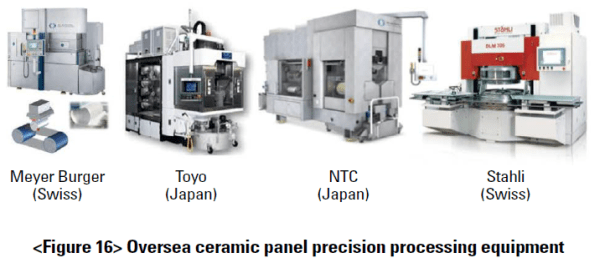
Plan to develop core technology of advanced
materials manufacturing system
Planning to develop technology based on credibility
The task of the advanced materials manufacturing system in not only to develop its equipment but also to support for securing credible data by developing credibility in equipment, processing technology, and its operation technology. A demanding company, when purchasing equipment, asks for assurance on credibility of technical function required at the site, compatibility with other equipment in production line, and process technology support besides of its specification. Therefore, in order to meet market
demand, following researches should be carried out together with equipment development; (1) equipment credibility improvement, (2) Process technology using equipment, (3) equipment operation technology, and (4) optimization of equipment. So, we are planning to provide demanding companies with objective credibility data by securing a specific period of time for additional improvement in credibility and optimization of developed equipment.
Task of existing R&D and Utilization of its relationship
Though the Analysis on National R&D Projects, we are planning to combine any of the necessary portions into the development of advanced materials manufacturing system technology. We are planning to develop core technology through intensive investment in inspection equipment, open type controller and operation S/W, which have high potential to be engaged with processing equipment field. For the processing equipment field, planning to develop specialized equipment optimized to processing advanced materials (carbon fiber reinforced plastic, titanium and sapphire) by utilizing core technology already secured through existing R&D.
Also, we are planning to secure product characteristics that are sought after by a client company. For development of specialized material in order to develop a processing process technology and for analysis on processing characteristics of the developed material, we need to secure characteristics of carbon fiber reinforced plastic for development of its equipment in connection with existing R&D project.
Plan to make an earlier commercialization of the achievements from development
We are planning to expand the high value added market by fortifying capability to meet requirements of demanding companies after securing a bridgehead for market expansion upon entering processing system market by using secured technology obtained at the early stage of the project through the bridge project (stepping stones bridge project) for earlier achievements and its commercialization from development.
We are planning to secure core technology by 2016 and to carry out earlier commercialization by entering the defense industry and domestic advanced material manufacturing industry market. We are panning to expand its market and to create new market with the step by step developments of processing system applicable the advanced
industry like automobile, aerospace and display industry by specializing and upgrading these technologies to the relevant market.
Activation of International cooperation
We need to promote international cooperation with researchers in overseas universities in order to obtain technologies in advanced countries, since these advanced technologies like the advanced material processing technology and system technology are prohibited to be exposed for protection from technology leakage. Especially, we are planning to appoint those international cooperation researchers as members of joint technology development as well as international liaison, and to utilize them as overseas strongholds and to increase efficiency of international cooperation by supporting business when domestic companies
enter the export market. Through these international cooperation researches, we provide consultant service on overseas activities to a project team and participating companies in association with appropriate authorities when they get involved with oversea exchanges. Especially, through positive utilization of prominent Korean researchers residing in overseas countries, we are planning to achieve maximization of research cooperation, to secure technology on the advanced materials manufacturing system in association with international community activities of the project team, and to support domestic companies’ entering global markets.
Core contents of the advanced materials manufacturing system development
Development of the carbon fiber reinforced plastic processing system
▒ Concept
In order to improve productivity of carbon fiber reinforced plastic part production industry, develops a production system package including processing, control, and inspection required to build a mass-production line.
▶Develops processing, quality inspection technology applicable to processing composite material parts in various forms and source materials, which includes development and process optimization technology of specialized processing system for CFRP, CFRP + metal
composite material parts in aerospace, automobile industries.
▶In order to improve productivity of the carbon fiber reinforced plastic – the material with high hardness difficult to cut, develops a package system applicable to mass production which incorporates a real time monitoring, inspection and post-processing system, an open type controller capable to respond flexibly to various processing processes, and modular SW/HW.
▒ Necessity
Because of rapidly increasing demand for a part with an ultralightweight material – carbon fiber reinforced plastic is expected from aircraft and automobile industries in accordance with the trend in products of environment friendliness and high efficiency and the carbon fiber reinforced plastic processing system has to satisfy productivity and quality standards required for its mass production.
▶Carbon fiber reinforced plastic, a material to cut due to bonding of high strength carbon fiber and polymer matrix, whose physical properties are subject to change in material manufacturing process needs to develop a suitable processing equipment and a proper process at the same time to develop control and inspection system flexible to respond to various processes.
▶Some core technology needed for the carbon fiber reinforced plastic processing system like 5 Axis Machine and water-jet have been developed in Korea, but, a processing system that includes equipment, process technology, inspection, and control is needed to develop since a processing development optimized to the carbon fiber reinforced plastic is not yet done.
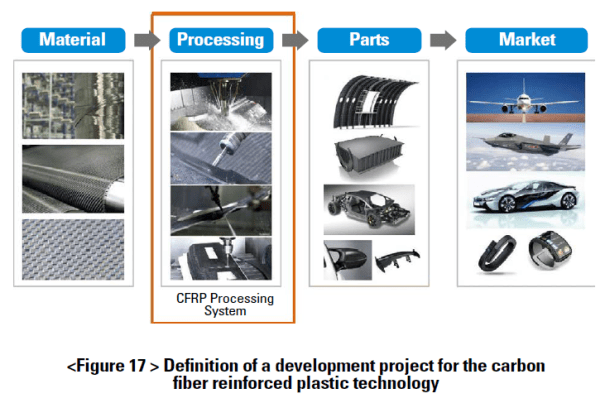
▒ Scope of Development
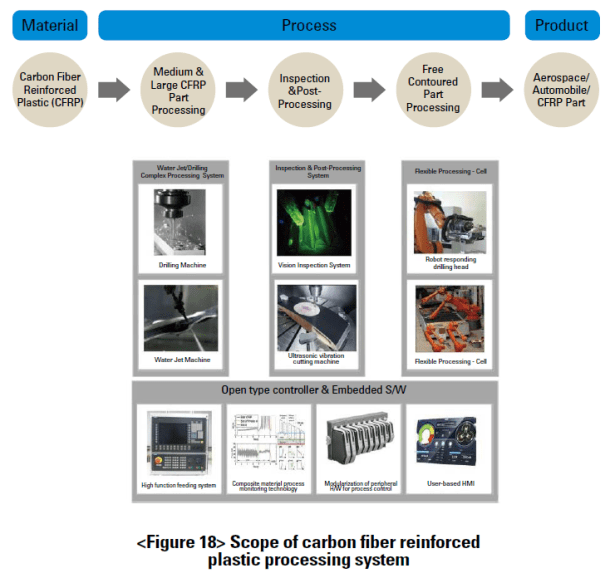
It is necessary to develop a medium- to large complex processing system in a unit equipment capable for featured cutting, contoured process, and hole processing in order to improve high production efficiency in the carbon fiber reinforced plastic processing, while
needed to develop an open-type controller responding to flexible processing cell, process for quality inspection and post-processing system, free contoured feature parts precision processing in a package system.
▶Development of 5-axis water jet, drilling complex machine for processing a medium and large carbon fiber reinforced plastic parts and the process optimization.
▶Development of core equipment component technology such as high pressure water jet unit, high power drilling head, inlet device to recover dust and recycling chips of carbon fiber reinforced plastic, and a flexible Jig system to secure 3D contoured parts.
▶Development of a processed quality inspection system and software considering characteristics of carbon fiber reinforced plastic.
▶Development of a post-processing system engaged with product quality control for improvement of part productivity.
▶Development of an open type controller capable for intelligent process control on carbon fiber reinforced plastic and metal composite materials.
▶Development of real time diagnose device for equipment and process considering characteristics of carbon fiber reinforced plastic that wears out its tools severely.
▶Development of flexible processing system for carbon fiber reinforced plastic precision processing in various sizes and shapes.
▶Development of an interpreting standard on material characteristics, a processing model and a processing process control technology.
▒ Business Plan
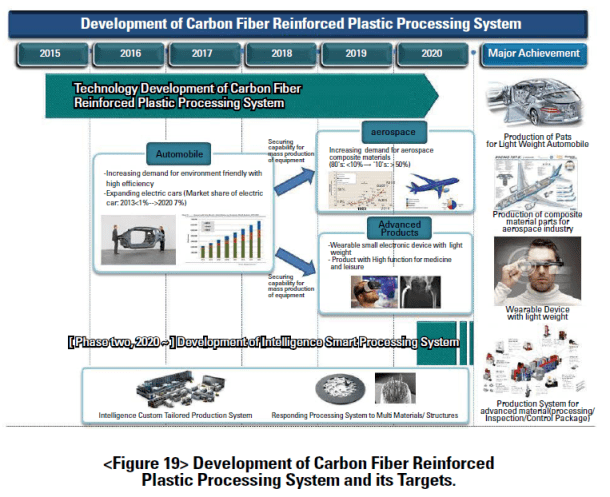
Developing a processing system package (process, equipment, controller, QC system) for improved productivity of carbon fiber reinforced plastic and apply it to mass production line.
▶Development by step: Process technology in carbon fiber reinforced plastic processing system → Automobile parts processing system → high precision parts processing system → future advanced parts (electric car, aircraft) processing system
▶Demand for carbon fiber reinforced plastic is expected to get bigger rapidly in aerospace and automobile fields as well as to all over industries such as energy, electronics and sporting goods. To secure original and fundamental technology in product processing and to heighten its manufacturing technology through development of processing system are required.
▒ Expected Effects
Securing fundamental technology of the world-best-level in the equipment and the process technology field of composite material molding and cutting for automobile and aircraft.
▶Overcome the limit of competitive edge in automobile, aerospace, and electric and electronic industries led by advanced countries which control core equipment for the future growth momentum industry.
▶Creating new market in the industrial field that uses carbon fiber reinforced plastic parts.
▶Accompanied growth of domestic molding industry through activation of the carbon fiber reinforced plastic parts processing technology and creation of new jobs in domestic transportation industry and device industry.
Development of the Jig Center class horizontal 5-axis processing system
▒ Concept
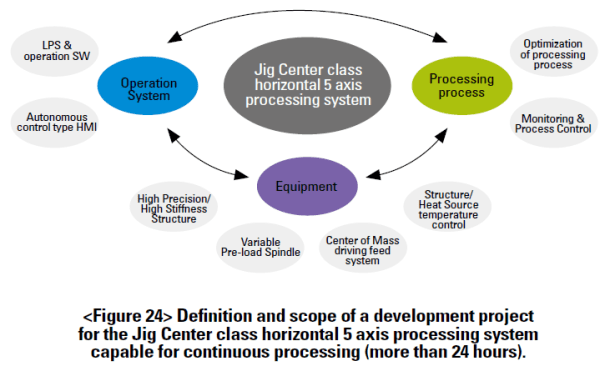
Developing of the Jig Center class horizontal 5-axis processing system (equipment, processing technology and operation solution) for difficult –to-cut complex contour parts in order to enter the global advanced parts market such as aerospace, power plant and off-shoe plant, and the next generation automobile and to improve competitive edge of the domestic processing industry.
▶Need to introduce the Jig Center class machining center capable for precision processing with higher yield regardless operator owing to the getting more complex features of a difficultto- cut new material part (engine case, blisk, etc.) whose usage keeps increasing in order to meet higher efficiency with lighter weight and extreme environment.
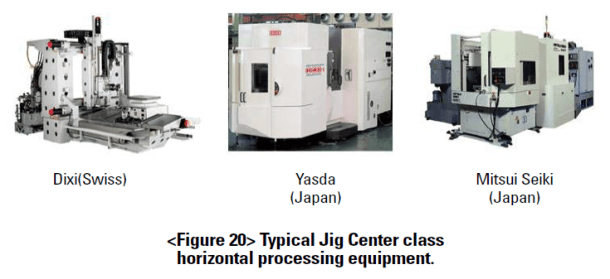
▶Jig Center has until now been developed by countries (Switzerland and Japan) that have the best precision related with cut-processing, and can be, in general, divided into a vertical Jig Borer) and a horizontal Jig Center.
▶DIXI in Switzerland, Yasda and Mitsui Seiki in Japan are supporting the advanced aerospace industry, development of deep sea resources by supplying specialized products with five-times accurate precision and two times stronger than common machines, and its application is spreading out gradually to common industries.
▶Since object part to be processed normally operating under high temperature and high pressure environment requires heatresistance, high strength, high stiffness, high hardness, abrasion resistance, it is typically manufactured with metal material difficult to cut like titanium and super alloy (Inconnel).
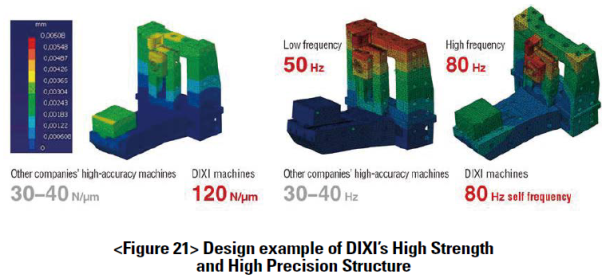
▶Different approach is needed for Jig Center from that for existing machine tool prior to developing equipment such as structure designing, processing and assembly, calibration in order to meet those required precision and strength.
▶Especially, in terms with the structural strength and precision, those advanced companies are materializing 120N/㎛ of loop stiffness between head-table, 70N/㎛ level of dynamic stiffness in head bending mode, 15㎛ of 3 dimension spatial precision, and 1㎛ level of repeatability.
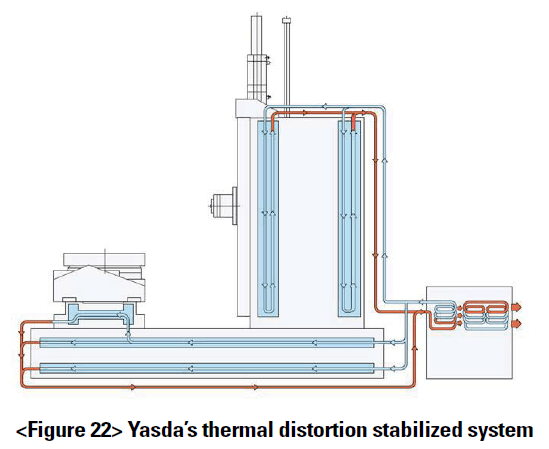
▶Most of Jig Center class devices operate a thorough heat control measures on major heat sources in an equipment including structures by using a large cooling unit in order not to degrade precision resulted from distortion of structures caused by changes in ambient temperature, temperature gradient, and internal heat sources in a device.
▶A spindle adopts a variable pre-load structure in order to realize heavy cutting at low speed and the low heat and high precision rotation simultaneously, and equipped with various sensors to measure spindle thermal error and vibration and respond to them.
▶In order to enter the rapidly increasing market for the advanced materials manufacturing system, not only equipment but also its processing process technology and automation solution are required, and these are the core equipment area for entering the high value added high-end equipment market.
▒ Scope of Development
Developing of a Jig center class 5 axis horizontal spindle processing equipment and its automated operation system with less than 1㎛ in repeated precision and more than 100N/㎛ in stiffness for continuous processing a difficult–to-cut complex featured part for a prolonged time of period.
Development of C-B axe type Jig center class 5 axis machine
capable for processing ultra alloy, titanium material
▶Development of a high precision, high stiffness 5 axis (C-B-ZX- Y) horizontal machine structure with a table in 600mm size.
▶Development of directly driven rotating table for controlling variable pre-load spindle and fitting-up workpiece random position.
▶Development of a high precision, low vibration feed system with minimized drive moment through driving the center of mass.
▶Development of improving technology in precision like controlling technology on structure temperature, 5 axis 3 dimension machine error calibration
▶Development of a machine resource control-centered autonomous control type HMI like large capacity tool magazine.
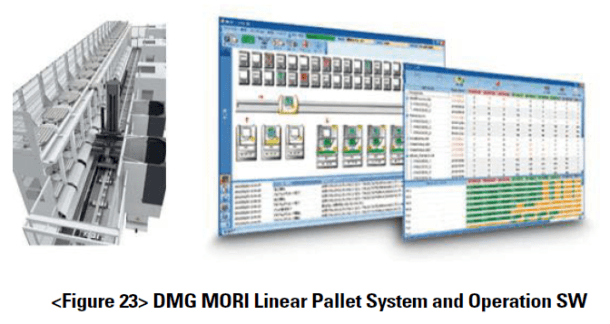
Development of unmanned processing linear pallet system
running more than 24 hours and its operation software
▶Development of an autonomous production operation software based on complex determination on in and out data of an equipment.
▶Development of a linear pallet system with more than 8 pallets and M2M function integrated loader/unloader.
Development of technology in process monitoring and
controlling a difficult-to-cut material processing
▶Development of a process optimization technology in 5 axis processing a difficult-to-cut material like Inconnel and titanium.
▶Development of detecting and controlling technology on a processing process defect through monitoring cutting signal and cutting oil pressure.
Development of a double sides sapphire glass processing
system with high productivity
▒ Concept
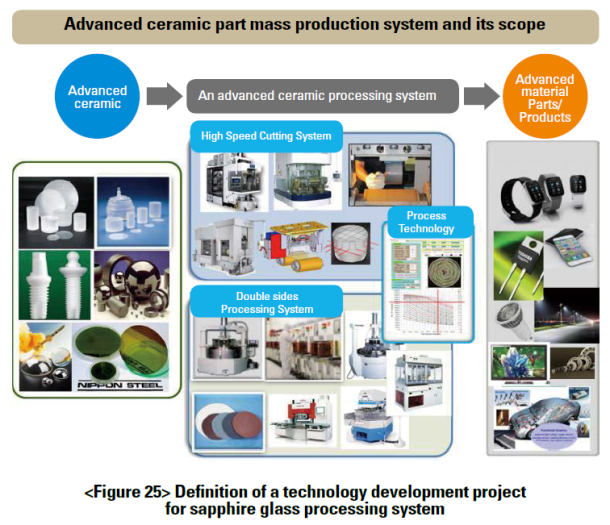
Developing of a processing system in a package required for mass production of sapphire glass for LED panel, Photovoltaic panel and smart device’s cover glass.
▶The market for sapphire glass, an advanced panel material for LED, smart phone and smart watch, is expected to grow KRW 5 trillion in 5 years. Need to secure fundamental technology in its manufacturing equipment and its process.
▶For a multi wire saw, almost monopolized by Japan and Switzerland, they are concentrating at raising the limit speed to exceed the maximum wire velocity 1200m/min or to overcome the obstacle in productivity improvement
▶The equal level of the wire saw has been developed domestically, but still needs to develop the fundamental technology in high speed wire saw in order to go beyond the global equipment technology and to develop equipment technology able to optimize shortened process and simultaneous double-sided processing by linking the double-sided processing machine development.
▶Obtaining competitiveness by reducing the number of processes to 60%, saving production cost by 30% and shortening production time by 40% through development of a fundamental technology for a complex process processing system and operation solution in order to obtain high efficiency and precision in ceramic material processing.
▶For activation of the sapphire glass market, innovative production equipment and process technology are needed, which can lower down current price per US$35 per sheet to US$ 25.
▶Technology to respond annual KRW220 billion of sapphire glass production equipment market through development of ultra speed wire saw capable to produce sapphire glass for high functionality smart electronic devices.
▒ Scope
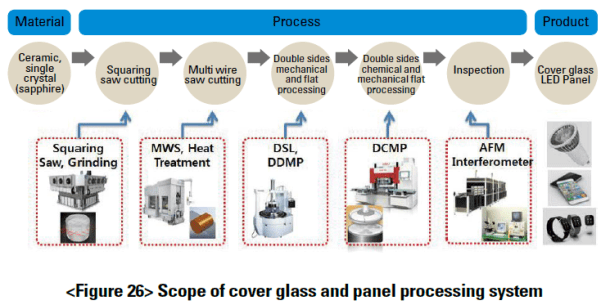
Developng of a wire saw for sapphire glass production for high functionality smart electronic devices and technology development of booth sides processing process and its linkage system for upgrading functionality of the ultra speed wire saw and for improving productivity.
▶(Equipment) Development of a ultra speed ( >1600m/min) wire saw equipment and a double sides simultaneous processing (double sides lap grinding) process equipment and reduction of production processes (from 16 processes to 14 processes) through process optimization.
▶(Process) Improvement of productivity by applying an ultra speed wire saw and a double sides simultaneous processing equipment (DLG-Double side Lap Grinding) and by optimizing production processes.
▶(Application System) Obtaining the high value added smart operation system technology by developing an ultra speed productivity equipment –process linked technology through technology development of continuous process in a wire saw and a double sides processing equipment.
▶World. Technology development in an equipment applicable to core fields of the future energy market such as photovoltaic panel, electric car, power plant, lighting panel both indoor and outdoor by obtaining technology on the highest productivity multi wire saw equipment and panel manufacturing process.
▒ Expected Effects
Securing market demand in and out of Korea by developing super-precision production equipment and obtaining fundamental technology in developing peripheral precision machining tools.
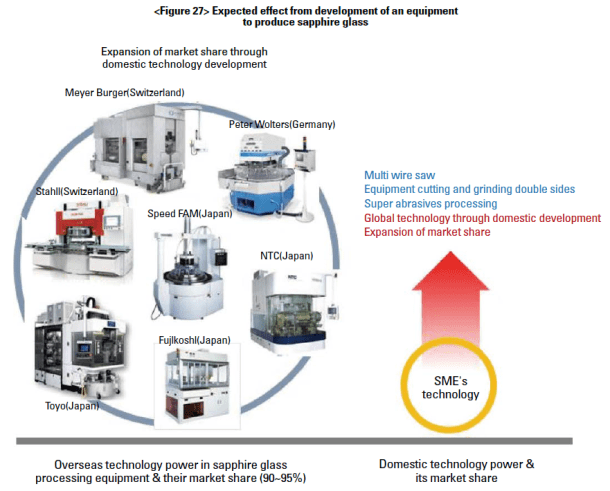
▶Korea has a relatively lower localization ratio for a production equipment to her position as a major producer in the world having 25%of the global sapphire market producing 2.4 million sheets of panels(based on 2 inch), especially the super precision wire saws are totally relying on importation from Japan, Germany and Switzerland.
▶From now on, within 2~3 years, the replacement timing for domestic equipment would come and its market for equipment is estimated to KRW160billion. Development of high value added equipment is required to meet this demand.
▶Direct effect is expected on development of multi axis, multi functionality precision machining tools triggered by development of super precision processing equipment.
▶Being a core equipment for an ultra hard glass and advanced ceramic panel, the highest value added equipment in process equipment being used in production of total flat plate ceramic and glass production, and an item showing 10~15% growth rate in annual average, it has a big ripple effect to other businesses due to the difficulties in developing its core technology once development succeeds.
▶Presently, we are relying 100% on oversea equipment owing to super precision control technology and precision credibility issues. We have to secure domestic and oversea market by localizing its fundamental technology and obtaining them in preparation for growth of the sapphire manufacturing equipment market.
Conclusion and Recommendations
The machine tool industry-the mother Machine for manufacturing industries- is the national key industry serving as a medium in industry eco-system of material-processing system-product.
Government and enterprises have achieved the result of the 5th in the world in terms of production by securing technologies in designing and production through positive investment on technology for the machine industry in the past, however it is the time when a new growth model is required for domestic machine tool industry that is in between with advanced countries’ market expansion with high functionality/high credibility equipment and Chinese market expansion strategy with price competitiveness.
When there is an increasing demand for advanced material products all over the world, we should take an upper hand in the advanced material high valued added production system field through the ‘First Mover’ strategy not through the existing ‘Fast Follower.’ In order to do this, we should precede such a development by predicting a future market for a high value added product, also, need a new business strategy to provide a processing system (HW + SW + Process technology) not a unit equipment. For this, support for earlier commercialization of any developed equipment and fundamental technology for the First Mover are required. In order to commercialize the developed equipment, securing credibility of the equipment is indispensable and a strategy to obtain authentication of the equipment and to establish the standard of its development technology should be carried out.
Also, it is prerequisite to foster specialized manpower at the developed equipment and the
related technology for steady development. In order to achieve this, a job creating strategy is required by expanding its market through carrying out projects comprised with industry, academy and research field and by exchanging manpower through a community related with the advanced material product.
At present, oversea equipment manufacturers take a control over the middle of its industrial eco-system due to lack of technology in production system that supports it, even though domestic material firms and product producers have a sufficient technology. In order to meet rapidly increasing demand for the advanced material parts, it should be urgently settled that an equipment industry structure is able to provide manufacturers in and out of Korea with custom tailored solution by developing production equipment in advance for a firm to run into a mass production. In order to foster manufacturing business capable to produce a high value added advanced material parts with competitiveness, prerequisite is to develop an advanced materials manufacturing system.
korean-electronics.com | Blog Magazine of korean electronics, brands and Goods



 Korean-Electronics.com