Since its establishment in 1974, LSIS Co., Ltd.  has grown as a global leader in the electrics and automation field, leading the global market by producing electric power solutions and systems, such as transformers, circuit breakers, LV/MV switchgear, etc. It also produces automation solutions, such as PLC, HMI, and inverters; and, in addition, the main parts of railroad systems and electric cars, the eco-friendly systems such as photovoltaic and energy storage systems.
Chairman & CEO Shin Dong-hyuk
Korea’s representative enterprise in the electrics and
automation field
LSIS Co., Ltd, established in 1974, is Korea’s representative enterprise in the electrics and automation field. After having seceded from LG Group in 2003, it was relaunched under the current corporate name. In 2015, it established the new vision of “Futuring Smart Energy” through the proclamation ceremony of value management. About 3,500 executives and staff members, including CEO Koo Ja-kyun, work for LSIS, which is composed of the Operation Headquarters including Smart Power Distribution, Smart Power Transmission, Smart Industrial Automation, and China Headquarters, and the Support Department, such as CTO.
The turnover in 2015 was about KRW2.2 trillion.
LSIS has its Head Office and R&D Campus in Anyang, and domestic places of business in Cheongju (1&2), Cheonan, and Busan (1&2), respectively, and overseas subsidiaries/branches in China, Vietnam, Japan, etc. LSIS produces electric power solutions and systems, such as transformers, circuit breakers, LV/MV switchgear, and automation solutions, such as PLC, HMI, inverter, and, in addition, the main parts of railroad systems and electric cars, and eco-friendly systems such as photovoltaic and energy storage systems.
For electric power solutions and systems, LSIS offers a whole lineup ranging from low-voltage solutions to extra-high voltage electric power, such as power transformers and GIS (gas insulated switchgear), and also high-voltage direct current (HVDC) and flexible alternating current transmission systems (FACTS) as well as alternating current system.
Pursuing various innovation projects
In the field of Smart Power Transmission projects, LSIS is pursuing its convergence/integration solution project grafting IT functions onto high-voltage power equipment and systems. Its main products consist of GIS (gas insulated switchgear), power transformers, etc. for transmission of electricity generated by a power plant, and PDPS (Power equipment diagnostic & Prevention system), high-voltage direct current (HVDC) transmission systems, etc., for stable operation of power equipment. LSIS provides both total solutions of high-voltage power system ranging from AC system to DC system and onestop solutions, from design to construction. Furthermore, LSIS also promotes eco-friendly and new projects, such as smart grids, automobile electronic systems, photovoltaic solutions, and railroad systems.
In the field of Smart Power Distribution projects, LSIS produces products of low- to medium-voltage, such as vacuum circuit breakers (VCB), air circuit breakers (ACB), molded case circuit breakers (MCCB), which are positively necessary for supplying power to facilities for industry, commerce and residences. In addition, LSIS fosters next-generation business, such as smart meters and IED (Intelligent Electronic Devices).
In the field of Smart Industrial Automation projects, LSIS provides various solutions related to factory automation based on the automation solution. Main products consist of PLC (Programmable Logic Controller), low- and medium-voltage AC Drive, HMI (Human Machine Interface), and LSIS also conducts business in automation systems and the E/S (Energy Saving) field.
To explain in detail the eco-friendly field, in the smart grid field, LSIS provides xEMS (energy-management solution) under the brand name of “GridSol.” The main solutions consist of HEMS, BEMS, and FEMS (for houses, buildings, and factories, respectively). Meanwhile, LSIS’s R&D Campus has recently obtained certification of BEMS installation for the first time in Korea. In the field of energy storage systems (ESS) attracting attention these days, LSIS provides solutions for commerce/ industry, frequency regulation and renewable energy applications, etc. under the brand name of “EnGather,” thereby helping utilize efficiently the electric energy stored in the battery.
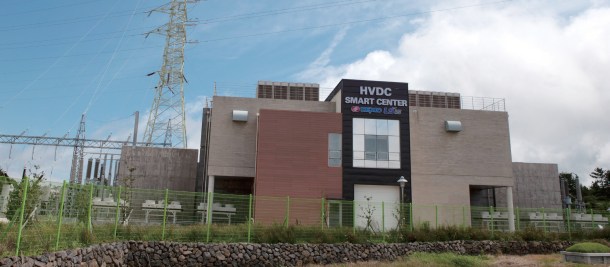
Persistently striving for localization of HVDC technology
LSIS has been persistently investing in the localization of HVDC (high voltage direct current) technology called the centerpiece of next-generation power transmission. HVDC is the technology of supplying power by converting the alternating current power generated at the power plant into direct current, and it is the method of power transmission which has recovered shortcomings of alternating current power transmission, such as loss of power transmission. Due to increase of long-distance power transmission demand, increase of construction of large-scale offshore wind complexes, increase of grid connection between countries, increase of grid stabilization demand, etc., HVDC is receiving attention as the core field of the next-generation electric power market. LSIS started the joint research with KEPCO (Korea Electric Power Corporation) in 2009 for developing the conversion technology, and has secured the operation technology by successfully installing the ±80kV, 60MW test site on Jeju Island.
Moreover, in 2013, LSIS was selected as the transferee of the HVDC core technology from KAPES (KEPCO-Alstom Power Electronics Systems Inc.), the joint venture company established by KEPCO and Alstom of France. LSIS also participated in the DC500kV-level HVDC project between Bukdangjin and Godeok, promoted by KEPCO and KAPES, and plans
to manufacture and supply key components of converter stations until the first part of 2017.
HVDC can be classified into LCC (line-commutated converter) and VSC (voltage-source converter) according to the conversion method (the semiconductor device used in the converter). Since ABB succeeded in commercial operation for the first time in 1954, LCC has become widely known all over the world, and in Korea, both 2 HVDC cable routes installed between the land and Jeju Island and the HVDC project between Bukdangjin and Godeok are LCC.
Though VSC (voltage-source converter) has a comparatively short history (succeeding in the commercial operation in 1997 for the first time), it is a field rapidly growing on the strength of the business environment changes such as expansion of offshore wind. VSC has still lots of shortcomings in price, loss, maximum voltage and capacity, etc. compared with others, but it has also many selling points─e.g. it is excellent in function, and requires only small space for installation. By combining HVDC with the prior technology research related to VSC-type HVDC from the beginning of HVDC business, LSIS has already secured the generic technology, such as control algorithm, and is preparing for entering into the market at the appropriate time of market advancement through product development utilizing similar technology, like MMC STATCOM.
FACTS (Flexible AC Transmission Systems) is the collective name of various compensation devices enhancing efficiency of alternating current power systems, among which SVC (Static Var Compensator) was supplied the most and STATCOM has recently started to capture the limelight. Technologically, SVC is similar to LCC-type HVDC, and STATCOM to VSC-type HVDC respectively.
LSIS already developed the ±100MVar-level SVC system and has succeeded in delivering the system to 154kV-level substation of LS-Nikko Copper Inc. and operating it. In addition, as mentioned above, LSIS plans to release the MMC STATCOM (the system evaluated as the most advanced STATCOM reducing power loss and minimizing the effect of harmonic wave compared with the existing STATCOM) utilizing the generic technology of HVDC.
Expecting to grow as a global leader in the field of nextgeneration
smart grid systems
It seems to be premature to comment on the result as there are still many technologies under development but, if LSIS secures the above-mentioned systems (LCC-type HVDC, VSC-type HVDC, SVC and STATCOM), it will be equipped with the AC/DC portfolio ranging from low voltage to extra-high voltage. LSIS thus expects to not only establish its reputation as the representative enterprise of electric power solutions and systems, but also operate the business stably by providing systems complementary to one another.
The smart-grid system nationally, will play a role in efficient operation of the power system, and the industrial system will contribute to enhancement of the power efficiency in steel plants, and so forth. If LSIS enters the global market where sales of HVDC and FACTS are rapidly growing, LSIS is expected to gain an advantage preferably in narrowing the gap between itself and the advanced global companies, compared with the market of existing alternating current power systems, which is evaluated to be mature in the aspect of technology/business/market.
Since initiation of the full-scale business/development in 2010, LSIS looks forward to the first sales of HVDC in 2016. If the business gets off the ground, LSIS expects not merely to increase sales but also to join the ranks of global leaders in the nextgeneration smart grid systems.


korean-electronics.com | Blog Magazine of korean electronics, brands and Goods

 Korean-Electronics.com