
Discovering and Fostering Start-ups in the Ceramics Industry
The Korea Institute of Ceramic Engineering and Technology (KICET), an affiliate organization of the Ministry of Trade, Industry and Energy (MOTIE), is the sole institute specializing in ceramics.
KICET has been contributing to the national ceramics industry development through not only carrying out research and development (R&D) on cutting-edge new materials in the ceramics field, but also executing such missions as testing & analysis & evaluation, corporate support, and policy support for the ceramics industry.

KICET, as an organizing institute of the start-up leap package support project from 2019 to 2022 aimed at helping Korean start-ups grow, is supporting start-ups for successful leaps through new businesses by facilitating the innovative growth of the start-ups.
The start-up leap package support project is supervised by the Ministry of SMEs and Startups (MSS), and is aimed at discovering and supporting competent Korean start-ups.
Korea’s start-ups – which have high potential for growth within their business career span of three to seven years – are entitled to receive such various benefits as financial aid, professional mentoring, support for advancement into domestic and overseas markets, etc.
Moreover, together with the support of commercialization capital including R&D support, such agency specialization programs as the technical support program, provide support for product upgrading, support for global competency enhancement, support for export, etc.
KICET discovered and fostered 22 start-ups as of 2021 and selected more than 20 start-ups last year, and is currently supporting these enterprises.
A high-ranking staff member of KICET recently noted, “We will do our best to steadily discover and foster more companies including three start-ups in 2022 – in order to ultimately nurture those start-ups as Korea’s representative enterprises in the near future.”


Ceramic Mesh
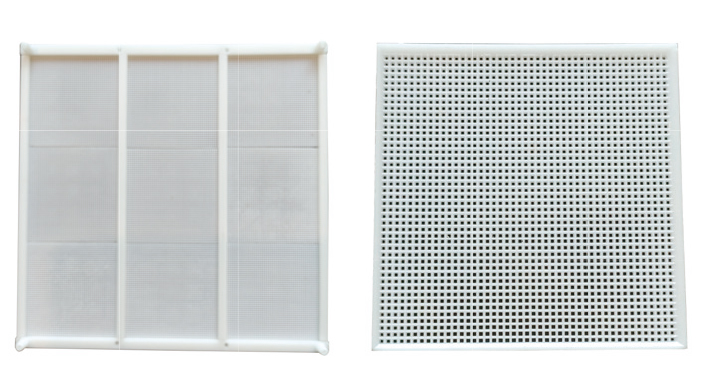
[INQ. NO. 2312E01] Nano Pore Ceramic Co., Ltd. was established in Icheon-si, Gyeonggi-do, near Seoul as a branch of the Korea Institute of Ceramic Engineering and Technology (KICET) in February 2021.
The business goal of Nano Pore Ceramic is to replace the current metal mesh type in which Multi-Layer Ceramic Capacitor (MLCC) manufacturers place nickel mesh on the ceramic jig and sinter it after placing the MLCC chips on the top of the jig.

World’s First Ceramic Mesh
The ceramic mesh (150 x154 x 1mm) that has been recently developed for the first time in the world is 1mm in thickness and 0.8mm and 0.2mm of the upper and lower pore sizes respectively, making it possible to handle 0603 and 0402 MLCCs.
In particular, the nano-pore ceramic can be stably mass-produced by using the ceramic injection method, thus satisfying customers’ needs. Major MLCC makers are located in Korea, Japan, and Taiwan.
Furthermore, the small-sized product (47x47x1mm) with the outer edges raised to prevent materials from flowing out can be used to replace sagger and crucible ones.
Dental 3D Printer

[INQ. NO. 2312E02] AON Co., Ltd. is a dental 3D printer and material manufacturer established in 2016. AON developed the world’s first liquid zirconia material for teeth and received FDA, CE, and KFDA certification.
AON currently provides printing technology for dental manufacturing such as crowns, bridges, veneers, etc., and implant membranes ‒ using dedicated printers.

ZIPRO printing device boasts high precision and resolution
ZIPRO printing equipment is dedicated printing equipment made of liquid zirconia material and provides high precision and resolution to accurately print the fitting of the patient’s gums and teeth. The material, INNI-CERA, is the world’s first to receive FDA and CE certification and offers improved economic efficiency and a variety of uses compared to zirconia blocks.
korean-electronics.com | Blog Magazine of korean electronics, brands and Goods



 Korean-Electronics.com