Exports reached 12.84 billion (up 8.4%) while imports were recorded as USD 6.21 billion (up 13.5%), resulting in a trade surplus of USD 6.63 billion.
Korea’s ICT product exports in February 2014 were recorded as USD 12.84 billion, up by 8.4% compared to the same period in the previous year. Korea’s ICT product exports increased evenly in the advanced and emerging countries based on export restoration in the U.S., European countries and Japan, as well as export expansion to ASEAN – Latin American countries.
By region, ITC product exports to the U.S. increased to USD 1.12 billion, up by 7.9%, while those to EU countries, Japan, ASEAN countries, and Latin American countries were recorded as USD 1.34 billion (up 1.9%), USD 0.53 billion (up by 19.7%), USD 1.65 billion (up 5.4%), and USD 0.76 billion (up 8.3%), respectively.
By item, mobile phones (USD 2.05 billion, up 37.7%), semiconductors (USD 4.47 billion, up 14.6%) and D-TVs (USD 0.53 billion, up 8.6%) all continued to lead the increase in exports.
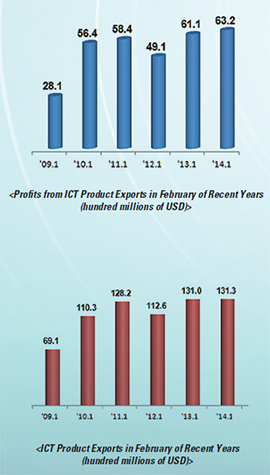 Korea’s ICT industry was in the black, recording a surplus of USD 6.63 billion, which served as a driving force to reach the nation’s trade surplus of USD 0.93 billion for the month. ICT product export performance and trade balance in February in recent years are shown in the figure below.
Overall imports of ICT products were recorded as USD 6.21 billion in February, up by 13.5% compared to the same period in the previous year. By item, imports of semiconductors (USD 2.59 billion, up 11.2%) and display panels (USD 0.42 billion, up 0.5%), and D-TVs (USD 0. 2 billion, up 21.7%), while imports of computers (USD 0.25 billion, down 8.7%) declined.
By region, imports from most countries such as China (including Hong Kong, USD 2.16 billion, up 15.6%), ASEAN countries (USD 1.01 billion, up 27.2%), the U.S. (USD 0.6 billion, up by 5.4%) and EU countries (USD 0.46, up by 9.7%) increased.
As well, it is expected that ICT product exports will remain strong mainly with restoration in the world ICT markets and growth of major items such as Smartphones, and semiconductors.
Seoul’s Export Similarity with Tokyo Touches Record Last Year
South Korea’s export similarity index(ESI) against Japan hit record last year. The ESIs were especially high for Korea’s major export items such as car and car parts, machinery and electronics. Once the weaker yen backed by the Abenomics starts to have a full impact, the export competition between the two countries would likely heat up further.
Korea’s ESI with Japan reached 0.501 last year, surpassing the 0.5 mark for the first time, said the Korea International Trade Association(KITA) recently.
The ESI quantifies the similarity of export product composition to gauge the competition among countries in foreign markets. The closer to one the reading is, the fiercer the competition is.
“A reading over 0.5 between Korea and Japan suggests at least 50 percent of the two countries’ export products are similar,” said Chang Sang-sik, a researcher at the Institute for International Trade under the KITA.
Considering the ESI with the world’s top trading country China stood at 0.377 last year, Korea’s gauge with Japan particularly stands out.
The index confirmed that even though several of Japan’s industries are losing competitiveness, the country is still Korea’s biggest competitor in the export market. By product, the ESI with Japan in auto parts, one of Korea’s top seven exports, came to a record 0.560.
Simplified Customs Procedures to Facilitate Direct Overseas Purchases
In order for the growing number of South Koreans seeking to purchase overseas products directly online, the Korea Customs Office is set to simplify related customs procedures.
Trading through direct purchases using special delivery services, international mail, or purchase agents stood at $1 billion, or 11 million cases, according to the KCO.
In 2011 and 2012, the figures were $470 million or 5.6 million cases and $700 million or 8 million cases, respectively, showing trading over the Internet has grown 113 percent in just two years in financial terms and 96 percent in terms of the number of transactions.
As direct purchases not only offer convenience to local customers but have the effect of bringing down prices at shops selling overseas products within the country, the organization will expand the number of items subject to tax exemption from the current six to ten. Such items which are imported for personal use and are priced at below $200 are exempted from customs tax.
Now, six items (clothing, shoes, toilet paper, kitchen utensils, printed materials, and luminaries) are exempted from customs tax but the organization plans to add four additional items of toys & dolls, electronics goods, fitness equipment, and accessories to the list within this year.
In addition to the simplification of the customs procedures, the organization is also considering relaxing requirements for a specially designated purchasing agent, which enjoys simple customs procedures and other benefits, from the current 100 million won ($93,005) in capitalization and more than 100 declaration records per month to 50 million won in capitalization and more than 50 declaration records per month.
korean-electronics.com | Blog Magazine of korean electronics, brands and Goods

 Korean-Electronics.com