Amid concern over the continued global economic recession caused by Europe is increasingly high, the Korean economy’s dependence on the foreign market is still escalating. The trade dependence degree, which is calculated by dividing the commodity and service’s total amount of export and import with Gross National Income (GNI), reached over 100% on a three consecutive years and this year it still remains at a nearly unchanged level. It means that the Korean economy is still struggling to free itself from the fragile economic effects of external shocks, due to the larger scale of foreign transactions than that of the economy itself.
According to the Bank of Korea, the Korean economy’s continuing dependence on the global economy is attributable to export-based growth of Korean economy caused by prolonged domestic demand, sluggish after the global financial crisis. The government agency released its official forecast that the Korean economy’s still high dependence on foreign market will likely easily and much affected by the fluctuations of the global economy as it suffered before.
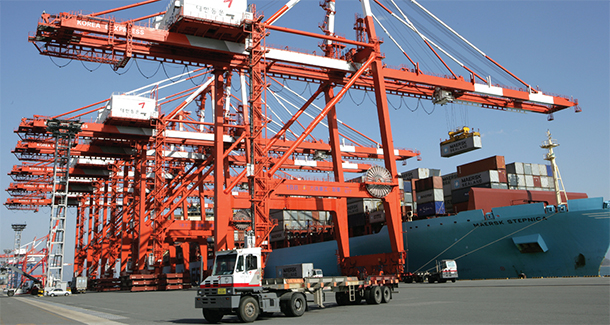 The Korean economy’s high dependence on foreign market is more prominent when compared to those of nations with similar size of economy. As of 2012, the export dependence degree of Korea (the world’s 14th largest economy) was 109,9%, exceeding the similar-sized global economies’ trade dependency degrees at that time(the 11th of Canada with 62.8%, 12th of Australia with 40.8%, 13th of Spain with 64.6%, and 15th of Mexico with 67.7%).
Even developed major countries’ trade dependence degrees on foreign market, such as the United States (30.4%), Japan (31.3%), France (57.1%), Italy (59.3%), and the UK (65.2%) are far lower than that of the Korean economy. Germany, a country having the highest trade dependence degree among developed nations, also remained at a lower level nations when compared to Korea’s.
Hyundai Research Institute recently said “The Korean economy’s high degree of trade dependence makes it highly vulnerable to external shock.” “Although the financial sector of foreign exchange reserves plays a role as safety valve against external shock, the Korean government needs to increase the ratio of domestic demand in GNI in a long-term and structured way.”
korean-electronics.com | Blog Magazine of korean electronics, brands and Goods

 Korean-Electronics.com