UNIST Academy-Industry Research Corporation (Guntae Kim, Prof. of School of Energy & Chemical Engineering)

Facing the situation that existing power plants using fossil fuel threaten even the survival of the human race, causing global warming and destroying the ecosystem, the whole world is striving for new & renewable energy research to substitute these plants. Moreover, as the anti-nuclear power movement is spreading due to stability issues for nuclear facilities, interest in new & renewable energy is increasing gradually; and solid oxide fuel cell (hereafter, SOFC, Solid Oxide Fuel Cell) is capturing attention as a next-generation electric power generation system while various new & renewable energy technologies are being introduced one after the other. However, enlarging the base of SOFC is still fraught with difficulties, due to many weakness of hydrogen and anode substance used as fuel. On this occasion, Prof. Guntae Kim’s team in UNIST Academy-Industry Research Corporation succeeded in developing new conceptual nano electrode for SOFC equipped with excellent performance and stability that can use existing hydrocarbon series fuel directly, which is expected to enhance the position of Korean fuel cell technology as well as SOFC base expansion.
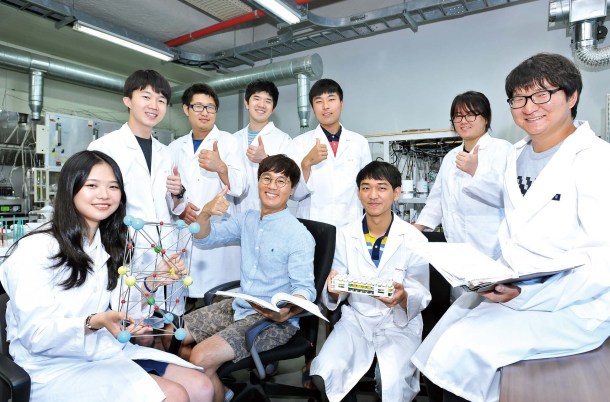
Overcoming the limitations of existing anode material
Since the first operation in 1937, countries advanced in the development of fuel cell technology, such as the United States and Japan, have intensively researched SOFC, called the thirdgeneration fuel cell, aiming for commercialization in the early 21st century, but the commercialization is making slow progress. This is because of high prices for making hydrogen that will be used as a fuel from hydrocarbon and difficulty in preserve, although SOFC is the most ideal environment friendly energy source that reacts hydrogen or hydrocarbon fuel with the air to create electricity and water. Moreover, Nickel Cermet that is commonly used for the anode of SOFC, has an advantage of high catalyst act in oxidizing the fuel but it cannot make full oxidization when hydrocarbon fuel, such as natural gas, methane, propane, and butane, is used, thus there is carbon deposition on anode surface, and problems to cause electrode damage due to the poisoning of sulfur impurities included in the fuel and to degrade long-tem stability in fuel cell operation due to such damage.
On this account, the need of developing is raised for SOFC anode material that can guarantee long time stability in output performance when various hydrocarbon fuels are used, and relevant researches were actively progressed accordingly.
Prof. Kim said that “Our research team started to develop anode substance that has strong tolerance against carbon deposition and sulfur poisoning created when existing hydrocarbon fuels like natural gas and LPG are directly used, and that can effectively solve performance and stability problems simultaneously”, and that “As a result, we developed double layered perovskite equipped with excellent performance and outstanding stability and applied it to new anode, which allows us to solve problems in existing anode materials, such as carbon
deposition and sulfur poisoning created when hydrocarbon is used, and to secure outstanding output performance successfully.”
Develop double layer perovskite, and achieve world-best performance
Prof. Kim’s team developed double perovskite perovskite where praseodymium (Pr) and barium (Ba) are crossing each other on perovskite, and utilize it to anode.
Therefore, carbon deposition on electrode surface and degrading fuel cell performance and stability due to the poisoning of sulfur impurities happened when using hydrocarbon directly as fuel with existing anode substance – Nickel Cermet – did not happen with double perovskite.
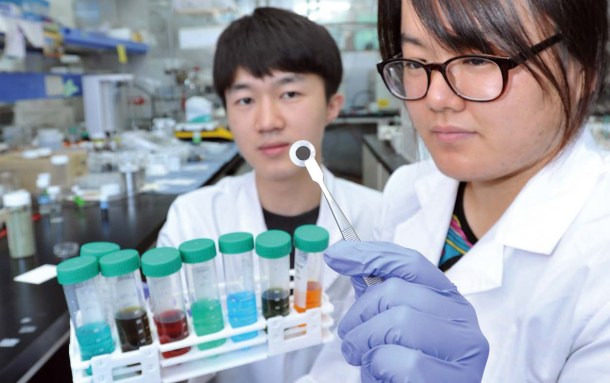
<Prof. Gun-tae Kim and his research is focusing on R&D based on the belief that SOFC will
become an essential energy source in future.>
Indeed, Prof. Kim’s team tested the performance of new electrode material. The world best performance were recorded in the results. There was no carbon deposition when propane is used in 700℃, and there was no voltage or current drop at all when operating fuel cell longer than 500 hours, but constant performance was maintained. Also, anode material developed from the research showed 1.7W/㎠ of output when hydrogen was used in 850℃, and 1.3W/㎠ of output when propane was used, which is more than 7 times higher performance and stability than Cu-ceria series anode electrode that showed 0.18W/㎠ of output. Therefore, it is confirmed that hydrocarbon series fuels like natural gas and LPG
can be used directly with new anode material. In this context, Prof. Kim said that “The world famous researchers have worked on using hydrocarbon directly without fuel reformer for sold oxide fuel cell. And there was a report in ‘Science’ in 2006 that 0.43W/㎠ of output was recorded from fuel cell operation with methane using anode substances developed through such researches. The anode material we developed showed 32% improved performance than above. For another anode substance reported in ‘Advanced Materials’ in 2012, 0.93W/㎠ of output was recorded with propane, whereas anode material we developed, showed 40% improved result, 1.3W/㎠ of output. Therefore, we can dare say that our development is the world best among anode substances that can use hydrocarbon series fuel directly”.


Paving the way to lead the world fuel cell industry: High expectations for its commercialization
Currently, Germany and some European countries possess the highest technology in the SOFC field, and closely followed by the USA and Japan. On the other hand, we have a technical gap of about 12% compared to the highest technical countries in Europe. To secure technical power equivalent to Europe countries, much more investment in technical development is urgent.
For material development, especially, the most important part in fuel cell development, Prof. Kim team’s research development would be an important momentum that reduces production cost for SOFC given that there are vigorous researches recently to reduce production cost for SOFC around advanced countries, and it can be highly appreciated for establishing a chance for our country to lead the world’s fuel cell industry.
Prof. Kim explained, “Our future goal is applying anode substance developed through this research to solid oxide fuel cell stack, producing fuel cells, and advancing into commercialized fuel cell era”, and he added that “When fuel cell using this anode substance becomes commercialized, each household may install compact SOFCs instead of boilers, get natural gas through already installed urban gas pipes, generate electric power, and use the waste heat created from the power generation for warm water supply; households can have self generation system. This self generation can reduce the utility cost by half, which may allow us to avoid a power crisis we are worrying about every
summer.”
However, there are too many issues to be solved before what Prof. Kim dreams of comes true. In particular, nuclear power oriented energy policy and misunderstanding on fuel cell are being pointed as the tasks need to be solved first. But, Prof. Kim highlighted that “I believe that if you have faith for what you are doing, you can get good results”, and “Although fuel cell get less attention then the energy generation and storage system for secondary battery or solar cell, if you keep concentrating on the research with a belief that it is an essential energy source in future, you will be finally compensated some time or other, and such sense of duty was a big driving force to succeed this research development.” As if composing a massive symphony, Prof. Kim’s research & development passion for fuel cells is literally hotter than the heat that comes from solid oxide using fuel cell. It is expected that such effort and passion will remove persistent obstacles and clear a new path to fuel cell power generation.
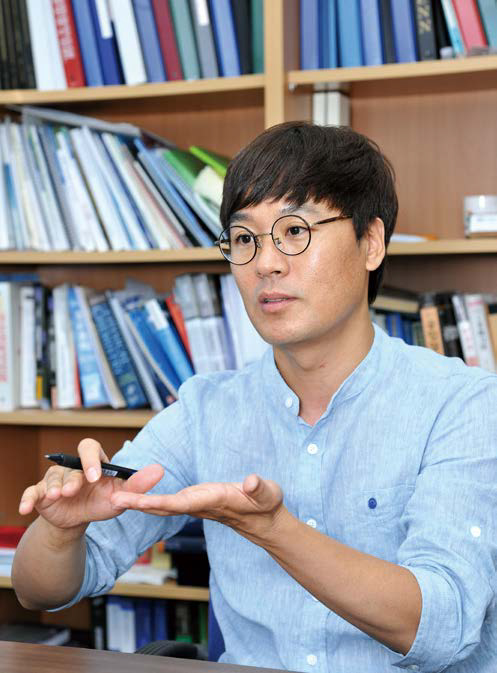
<Guntae Kim, Prof. of School of Energy & Chemical Engineering>
korean-electronics.com | Blog Magazine of korean electronics, brands and Goods



 Korean-Electronics.com
Leave a comment