
China’s Container Shipping Capacity Nearly Triple that of South Korea’s
Major international container shipping companies, particularly those in China and Japan, have aggressively expanded their fleet capacity over the past three years, widening the scale-gap with South Korean shipping companies. Shipping capacity refers to the total cargo-carrying capacity of a vessel fleet and is a key indicator of a country’s influence over global trade.
Although major South Korean shipping companies have also moved to expand their fleets, their pace of growth has lagged behind that of overseas competitors.
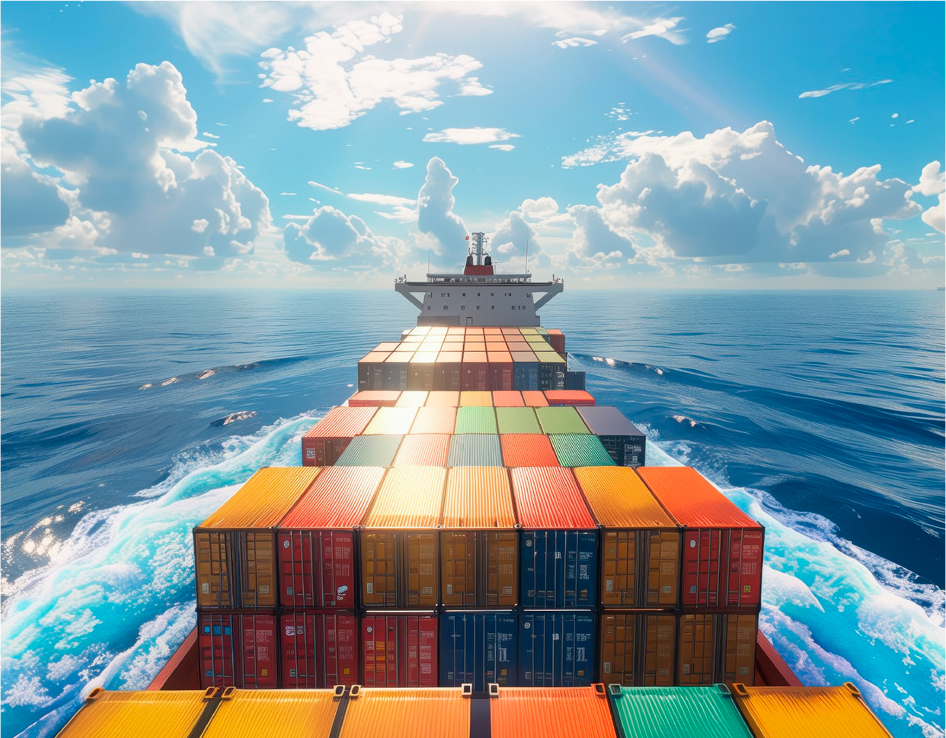
An analysis of operational fleet capacity rankings by country compiled by global shipping research firm Alphaliner shows that there are 15 Chinese companies (excluding Hong Kong) among the world’s top-100 container shipping lines with a combined capacity of
4,306,488 TEU. This was 2.9 times the combined capacity of 1,478,217 TEU operated by eight South Korean shipping companies. (One TEU is equivalent to the capacity of a standard 20-foot container).
Taiwan and Japan also substantially outpaced South Korea. Five Taiwanese shipping companies, including Evergreen, Yang Ming and Wan Hai, had a combined fleet capacity of 3,655,912 TEU — 2.5 times that of their South Korean counterparts. In Japan, three companies, including Ocean Network Express (ONE), operated a combined
2,207,919 TEU, approximately 1.5 times South Korea’s capacity.
Of the approximately 34.88 million TEU in total global operational capacity, Chinese companies accounted for 12.3%, followed by Taiwanese companies at 10.4% and Japanese companies at 6.3%. By comparison, South Korea’s share stood at just 4.2%.
In South Korea, HMM Co Ltd. (formerly Hyundai Merchant Marine) ranked eighth globally, with an operational fleet capacity of 1,034,348 TEU, maintaining its position since 2020. It was followed Korea Maritime Transport Co. Ltd. (KMTC) at 15th (163,876 TEU), Sinokor Merchant Marine at 19th (132,526 TEU), SM Line at 32nd (66,801 TEU) and Namsung Shipping at 42nd (39,768 TEU). Differences in fleet expansion rates were also evident when comparing major shipping companies in South Korea, China, and Japan, respectively.
According to Alphaliner, HMM’s operational fleet capacity increased 26.7%, from 816,365 TEU in March 2023 to 1,034,348 TEU in October this year. Over the same period, Japan’s ONE expanded its capacity by 43.0%, from 1,531,880 TEU to 2,191,058 TEU, a growth rate 16.3 percentage points higher than HMM’s.
COSCO Group, China’s largest shipping company, recorded a relatively comparable growth rate of 27.4%. However, its absolute capacity increase amounted to approximately 790,000 TEU, 3.6 times HMM’s increase.
korean-electronics.com | Blog Magazine of korean electronics, brands and Goods


Leave a Reply