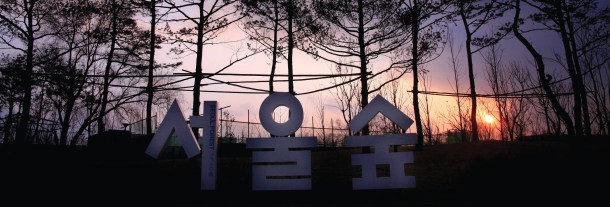
Seoul Forest is the metropolitan government’s answer to Central Park in New York City. Based on its plan to create a forest in the Ttukseom area, the metropolitan government worked for one year to open the vast, artificially formed forest to the public in June 2005.
The forest covers some 1.15 million m2 of land, with a total of 420,000 trees of 104 different species were transplanted here to emphasize the ecofriendly image of the forest. The trees are about 20 meters tall and 30 to 40 centimeters in diameter. Oak, hornbeam and cherry trees are most common here, most of which are of Korean origin.
The forest consists of five areas under different themes. The first themed land is called “TtukSeom Culture and Art Park,” which includes a plaza, outdoor stage, an artificial pond, an atelier and a gateball court. The second one is “TtukSeom Ecology Forest, a grand ecological forest which is home to such wild species as the Formosan deer, Chinese water deer, squirrels and fallow deer (they were released into the forest when it opened) (a guided tour is available).
The area is connected to Hangang Waterside Park via a 472-meter -long bridge. “Wetlands Ecological Field”, the third area, features a bird observatory, an eco-friendly playground and Jeongsu botanical garden. The fourth area, “Hands-on Nature Learning Center,” is a place where visitors can gain hands-on knowledge and see examples of various plants. This area also features Gallery Garden, a greenhouse and a flower garden made from the water purifying facilities which had long been used here. The fifth area is Hangang Waterside Park which includes a cycle trail and a boat terminal.
Location: 273, Ttukseom-ro, Seongdong-gu, Seoul


korean-electronics.com | Blog Magazine of korean electronics, brands and Goods


 For the upcoming KOBA 2016, we expect an even better response with the exhibition area of 27,997sqm covering three halls(COEX A, C, and D). The KOBA Show has grown continuously with Korea’s broadcasting, audio and lighting equipment industry and it has become a hub exhibition of Asia. Over 950 companies from 35 nations including South Korea (189 manufacturers), the U.S., Germany, the UK, Japan, China, Taiwan, and France are expected to exhibit and demonstrate cutting-edge technologies and equipment at KOBA 2016. More than 50,000 visitors including professional buyers are expected to visit.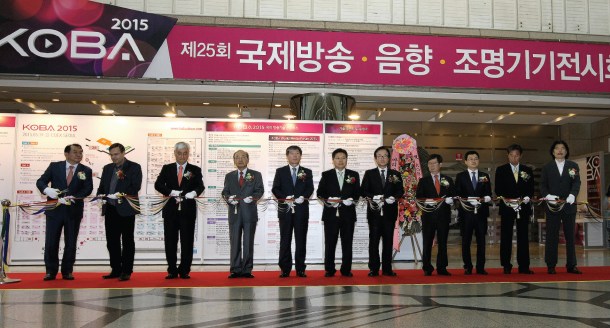


 Since 2008, GMV has played a crucial role in the Korean mobile industry as a global marketplace. Also, it contributes to the increase of mobile and IT enterprises’ sales in both domestic and international markets.


 It is diff erent from the concept of ‘World Class Products’ that are selected by the Ministry of Trade, Energy and Industry based on the comprehensive evaluation on Korean product’s share in global export market (top 5), technology, marketability, etc. A total of 17 new products such as chemicals (5) and steel (4) made no.1 position in terms of worldwide market share while 18 products, including steel (4) and textile (4), lost their top position to other competitors. 47 items such as memory chips continued to secure their top selling status from the previous year.
 In the event of a sudden increase in temperature, the smart rack will go into emergency operation mode to compensate and quickly reduce the heat. An alarm is set off and an alert message is sent to designated users via phone or email. For quick and easy maintenance the A/C unit simply slides out from the bottom of the Rack and can be repaired or replaced for repairs elsewhere.
 PPI has become one of the leading manufacturers of the optical electronics industry in Korea, successfully utilizing its superb original technology in developing planar light wave circuits to produce the optical power splitter and arrayed waveguide grating (AWG).
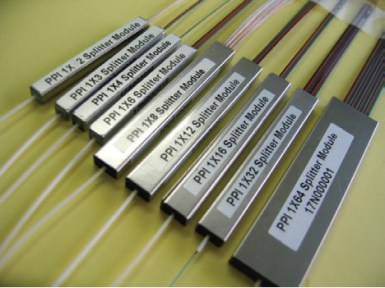 PPI’s optical power splitter is designed to be used in FTTH to separately transmit the signals that are sent from the telephone office or the cable stations through a single optical cable to multiple membership locations (apartments and houses), thereby constituting a key component of the optical membership network. PPI’s manufacturing capacity of components ranged from chips to modules reached the global upper-level, enabling the company to actively lead the global technological trend.