Korea concludes a bilateral FTA with Vietnam

Korea and Vietnam recently officially concluded a free trade agreement with Vietnam. The two countries, which are under the Korea-ASEAN FTA, are expected to expand bilateral trade with the further upgraded FTA. The Korean government has set a goal for the implementation of the FTA within this year through follow-up procedures such as ratification by the National Assembly.

The Korea-Vietnam FTA was recently officially signed by South Korean Minister of Trade and Industry and Energy, and his Vietnamese counterpart in Hanoi. Under the bilateral FTA, the countries would seek to further expand their bilateral trade based on the Korea-ASEAN FTA which came into effect in June 2007. Under the Korea-ASEAN FTA, Korea has eliminated its import tariffs on 91.7 percent of products delivered from Vietnam. Korea would raise it to 94.7 percent while Vietnam would increase it from the existing 86.3 percent to 92.4 percent.

Regarding the number of products, Korea would completely remove its import duties on 499 products and Vietnam on 272 goods, within 15 years. In particular, the FTA would eliminate tariffs on home appliances, cosmetics and major parts of cars, which were excluded from the Korea-ASEAN FTA, within 10 years to contribute to the expansion of exports of Korean products. The Korean Trade Minister explained, ”The Korea-Vietnam FTA will help Vietnam’s economic development and boost bilateral trades by expanding Korean firms’ investment in Vietnam,” adding that it would be a good example of “a mutually rewarding FTA.”


korean-electronics.com | Blog Magazine of korean electronics, brands and Goods
Korean items rank first in global export market share

-The number has slightly increased for two consecutive years from 61 in 2011 and 63 in 2012-

There were as many as 65 Korean export items that ranked first in global export market share in 2013, increasing slightly from 63 items in 2012 and 61 in 2011 which all boosted the country into the 12th place from 14th in 2012 and 15th in 2011.

According to a report titled “Korea’s Exports Competitiveness Reviewed through Global Exports Market Number One Items” issued by the Institute for International Trade (Kim Keuk-soo, http://iit.kita.net) of Korea International Trade Association on February 5, as of 2013, China took the first place with 1,538 first ranked Chinese items in the export market. It was followed by Germany (733 items) ranking second, the United States. (550 items) ranking third, and Italy (216 items) ranking fourth. China had 63 more number one items than the previous year while 44 Japanese items disappeared from the top of the list.

For two consecutive years from 2012, the number of Korean items that maintained the first place in their global export market share was 44, including memory semiconductors, auto parts, and tankers. The number of new items to rank first in 2013 was 21, which came mostly from chemical products and textile goods such as ethylene, polycarbonate, and apparel accessories. In contrast, 19 items including steel and agricultural and marine products stepped down in 2013 from the number one list of 2012.

By item, Korea has generated plenty of number one export market share products from chemical products (21 items), to steel (11 items), and textile products (8 items), etc. Over the past six years, the number of chemical products that took first place in export market share has increased while those of transportation machinery, electronic machinery and agriculture and fisheries have shown downward trends.

Among Korea’s 65 number one items, 37 items are in competition with China (20 items), the United States (10 items) and Japan (7), whose items ranked second in export market share. In particular, 14 items, including memory semiconductor, China is closely trailing Korea as the gap of export market share between the two countries is less than 5 percent. Meanwhile, those three countries stood first with 124 items and Korean products are competing with them by ranking second or third.

In terms of the major export destinations, the number of Korea’s number one export items in China and the United States were 372 and 84, respectively in 2013, and ranked 5th and 9th in those countries that were the same as the previous year. Especially, the number of items with the largest export market share in China rose significantly (37 items) and eight more items ranked first in the U.S. market, as well. On the other hand, the number of Korean products that held the first place in export market share in Germany in 2013 increased to 20, which was 1 more than the previous year, and Korea stood 15th(except EU countries).

Moon Byung-ki, a senior researcher at KITA mentioned “The number of Korean export items that ranked first in global export market share in 2013 has grown for two consecutive years since 2011 and Korea stepped into 12th”. He stressed “Korea needs to focus on the items that are competing with China, Japan and the United States for the first place in global market share in order to secure the competitiveness in technology and quality through innovation. At the same time, the measures to foster the expansion of number one items are required at governmental level”. (Source: KITA)


korean-electronics.com | Blog Magazine of korean electronics, brands and Goods

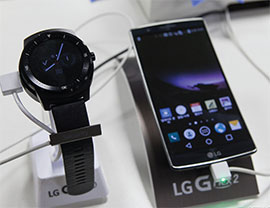
LG Electronics’ release of its second curved Android smartphone

LG Electronics unveiled its new curved smartphone and other innovative products at the recently closed International Consumer Electronics Show(CES) in Las Vegas.

The Korea’s second largest maker’s second curved Android smartphone G Flex 2 has more powerful specifications and is more curved than its predecessor G Flex. It offers a six-inch full high definition, plastic OLED display.

LG-Android-smartphone The new screen is 1,080 x 1,920 pixels in size and the maker is confident that the device can withstand 20 percent more force to prevent breaking. It also has the noticeable feature of the former model G Flex’s self-healing back plate that recovers from scratches in just 10 seconds.

The G Flex 2 is also considered the world’s first phone equipped with a 64-bit Octa-Core Qualcomm Snapdragon 810 chipset. Its cameras have also been upgraded, with a 13- megapixel rear camera with laser auto focus, and a 2.1 megapixel front camera.

Battery capacity is 3,000mAh with fast-charging capability, which the company calls for will take less than 40 minutes for a 50 percent charge from zero.

The G Flex 2 will come in two colors – Platinum Silver and Flamenco Red. It will be launched this month in Korea, then in other regions. LG also disclosed its Internet of Things (IoT) platform strategy.

Korea develops ultrasound-guided HIFU apparatus for 1st time in its history

As many as 300,000 Korean patients of uterine myoma are expected to take the opportunity to receive treatment quickly and effectively with local equipment from this year.

Alpinion Medical Systems, a company specializing in ultrasound medical devices and a subsidiary of Iljin Group, said last year that it has developed a treatment apparatus utilizing High Intensity Focused Ultrasound (HIFU) and has recently given final permission of medical appliances in the manufacturing list by the Ministry of Food and Drug Safety.

Some Korean companies including Alpinion and Samsung Medison have already developed and sold ‘ultrasound imaging apparatus’ for diagnosis of diseases but this is the first time for Korea to develop the HIFU apparatus which needs far higher technical skills with local technology. About 20 medical device manufacturers around the world tried to develop the HIFU apparatus but a few global companies such as GE and Philips succeeded in releasing the product on the market because of high technical barriers.

The product can get rid of tumors from diseased areas of a uterine myoma patient, which helps the reduction of unnecessary total hysterectomy. In particular, Alpinion has raised anticipations of possible time and cost savings as it applied ultrasound-guided method instead of magnetic resonance imaging (MRI)- guided method used by most of its competitors.

Korea’s trade surplus reaches $100bn in the components and materials industry

Korea achieved a trade surplus in the components and materials industry topping the $100 billion mark for the first time in its history. This means the components and materials industry grew in qualitative and quantitative terms, serving as a cornerstone for the manufacturing industry, despite the fact that the rise in exports of components and materials is partly attributable to the relocation of the local manufacturing bases to overseas.

Korea’s-trade-surplus The Ministry of Trade Industry & Energy recently reported that exports of the sector posted $276 billion while imports reached $168.1 billion, putting the sector’s trade surplus at $107.9 billion to exceed $100 billion for the first time.

The nation’s components and materials industry accomplished $100 billion worth of trade surplus in 17 years since 1997 when the trade in the industry turned to surplus for the first time. Trade surplus in components and materials amounts to 2.3 times higher than the nation’s total trade account of $47.4 billion last year.

Korea’s-trade-surplus_1 Last year, exports of components increased 5.9 percent from a year ago to $188 billion backed by the recovery of demand industry in major advanced nations. Exports of materials reached $88.1 billion, up 3.0 percent from 2013, as the demand for non-metallic minerals and primary metal products picked up.

Such impressive growth of the industry represents basics to the domestic industry has been improved. And it is also a noticeable fact that the local companies’ relocation of their production facility to China and Southeast Asia is another important factor leading the industry’s growth.

Three kinds of obstacles facing Korean exports

South Korean exports are facing three kinds of difficulties. Small and medium-sized enterprises (SMEs) are suffering in the face of the yen’s decrease amid their trade dependence on certain nations such as China is increasingly growing. After the rapid export growth of automobiles and cell phones, which have driven the nation’s exports for two to three years, the nation is still exploring new growth engines other than semiconductors. This unstable status of the export environment is thus posing a threat to the Korean economy.

Korean exporters are on alert over fluctuations of foreign exchange rate, which determine their price competitiveness and profitability. As the yen is decelerating at a faster speed with the US’s end of quantitative easing programs, Korea’s exports to Japan during the January-September period recorded $23.5 billion, down 4.1 percent from the same period a year ago. The yen’s drop is leading the nation’s companies to risk losing their competitiveness in the United States and EU.

obstacles-facing-Korean-exports The devaluation of the yen is also serving as an obstacle to Korean exports to China. The decision to extend the Korea-China currency swap deal is part of efforts to offset the weaker yuan. Amid the stronger won and weaker yen in the first half of this year, the won-yuan exchange rate appreciated as much as 9.3 percent.

Against the expectations that conclusions of a series of promising free trade agreements would broaden the nation’s trade territory, trade dependency on specific areas is growing. The trade balance with the EU already exceeded a $6.5 deficit in September this year while the trade deficit with the EFTA is expected to reach $3.9 billion this year.


korean-electronics.com | Blog Magazine of korean electronics, brands and Goods

S. Korea to conclude three free trade with China, Vietnam, and New Zealand

Korean government is working to conclude further free trade agreements (FTA) with China, Vietnam, and New Zealand within this year in order to help domestic companies’ exports in the global market. The government is now under pressure to facilitate Korean companies’ exports to Vietnam while responding to China’s policy of growing its domestic market. Also, in a move to stay ahead of competitors, including Japan, the nation strategically already suggested a deal for an FTA with Vietnam.

A spokesperson responsible for the Korean government’s FTA policy noted “Conclusion of a Korea-China FTA within this year has great importance, given the fact that Chinese government is now swiftly changing its policy for economic growth from the export-based to local market-based. The conclusion of the FTA aims to secure early advantages in China’s domestic market.”

The Korean government estimates that once the Korea-China FTA is effectuated, Korea’s exports to China would increase from 5.4 percent to 5.5 percent and the nation’s gross domestic product (GDP) also should grow from 2.28 percent to 3.04 percent within 10 years after the effectuation, according to the level of trade concessions.

Between Korea and Vietnam, a trade agreement was concluded through the Korea-ASEAN FTA. But, Vietnam is a late participant in the FTA, so that the commodity group’s transition into a group in the tariff-free condition is scheduled to be carried out by 2020. And the percentage of the commodity group excluded from trade concessions is high. Now more than 3,300 Korean companies operate in Vietnam, and from the Vietnam side, elimination of tariffs between Korea and Vietnam is urgent as Korea comprises 30 percent of total exports.

The trade level between Korea and New Zealand is not so high, but it plays a big role for Korea not to lose its competitiveness in the area in a trade race between Korea and rival trade nations including China. China also enjoys nearly double increased exports ahead of effectuation after announcement of China-New Zealand FTA.


korean-electronics.com | Blog Magazine of korean electronics, brands and Goods
Still too high degree of Korean economy’s trade dependence

Amid concern over the continued global economic recession caused by Europe is increasingly high, the Korean economy’s dependence on the foreign market is still escalating. The trade dependence degree, which is calculated by dividing the commodity and service’s total amount of export and import with Gross National Income (GNI), reached over 100% on a three consecutive years and this year it still remains at a nearly unchanged level. It means that the Korean economy is still struggling to free itself from the fragile economic effects of external shocks, due to the larger scale of foreign transactions than that of the economy itself.

According to the Bank of Korea, the Korean economy’s continuing dependence on the global economy is attributable to export-based growth of Korean economy caused by prolonged domestic demand, sluggish after the global financial crisis. The government agency released its official forecast that the Korean economy’s still high dependence on foreign market will likely easily and much affected by the fluctuations of the global economy as it suffered before.

Korean-economy’s-trade-dependenceThe Korean economy’s high dependence on foreign market is more prominent when compared to those of nations with similar size of economy. As of 2012, the export dependence degree of Korea (the world’s 14th largest economy) was 109,9%, exceeding the similar-sized global economies’ trade dependency degrees at that time(the 11th of Canada with 62.8%, 12th of Australia with 40.8%, 13th of Spain with 64.6%, and 15th of Mexico with 67.7%).

Even developed major countries’ trade dependence degrees on foreign market, such as the United States (30.4%), Japan (31.3%), France (57.1%), Italy (59.3%), and the UK (65.2%) are far lower than that of the Korean economy. Germany, a country having the highest trade dependence degree among developed nations, also remained at a lower level nations when compared to Korea’s.

Hyundai Research Institute recently said “The Korean economy’s high degree of trade dependence makes it highly vulnerable to external shock.” “Although the financial sector of foreign exchange reserves plays a role as safety valve against external shock, the Korean government needs to increase the ratio of domestic demand in GNI in a long-term and structured way.”


korean-electronics.com | Blog Magazine of korean electronics, brands and Goods
Korea’s ICT exports reach historic high in the 1st half of 2014

ICT exports for the 1st half of 2014 reached USD 83.83 billion, a year-onyear increase of 3.2%. ICT imports for the same period reached USD 42.15 billion, a year-on-year increase of 7.4%, and the trade balance of Korea’s ICT showed a surplus of USD 416.8 billion.

ICT-exports_1 Despite worsened external conditions including the slowdown of global ICT growth and the decline in the exchange rate, Korea’s ICT reached a historic high, and the daily average export also reached a peak (as of the 1st half of 2014).

The ICT balance showed a surplus of USD 41.68 billion, contributing to Korea’s overall trade surplus of USD 20.28 billion. In the ICT sector, exports of semiconductors and mobile phones were extremely robust, and SMEs recorded large exports.

Key ICT items including semiconductors and mobile phones led the growth in exports, playing a central role as key competitive areas despite the recent low growth trend of the global ICT market.

Semiconductors recorded the largest exports in the 1st half of 2014, prompted by a large increase in market share in the mobile sector and the unit price increase of DRAM.

Korea strengthened its global presence in the mobile phones sector, achieving the largest global market share despite the slowdown in the growth of the smartphone market and the challenges posed by Chinese companies.

It is expected that Korea’s ICT sector will continue to grow in the second half of 2014 thanks to the recovery of ICT demand in advanced economies and the moves made by Korean manufacturers to win emerging markets including China, based on competitiveness in key items.

Negative factors that will affect ICT exports in the 2nd half of 2014 include the decline of the global ICT growth rate, the decreased unit price of memory and semiconductors, the challenges posed by Chinese smartphone manufacturers and the strong Won.

ICT-exports


korean-electronics.com | Blog Magazine of korean electronics, brands and Goods
S. Korea’s exports to China slow down this year

South Korea’s exports to China amounted to US$42 billion from January 1 to April 20, according to the Ministry of Trade, Industry and Energy (MOTIE). The figure grew merely 1.5 percent from the same period a year ago.

The growth rate is slower than an 8.7 percent yearon-year (YOY) jump. The portion of China-bound exports out of Korea’s total exports recorded 24.9 percent this year, down from 25.1 percent last year. The ratio was the highest of 26.1 percent last year.

Korea’s exports to China expanded at 2.4 percent in April (estimated figure). This contrasts with those to the United States and ASEAN which recorded a 19.3 percent and 17.0 percent rise, each. This is attributable to China’s sluggish exports and economic growth. China’s exports for the first quarter contracted 3.4 percent while its economy grew 7.4 percent in the first quarter, falling short of its annual growth target of 7.5 percent.


korean-electronics.com | Blog Magazine of korean electronics, brands and Goods