[INQ. NO. 2609E01] While the scope of drone applications is expanding from wildfire monitoring to military reconnaissance and maritime surveillance, short flight times remain a challenge that needs to be addressed. Consequently, wired drones, which perform long-duration missions by supplying power directly rather than using batteries, are drawing attention as a better alternative.
Korea Aviation Technologies (KAT), a developer of manned and unmanned aircraft, exhibited a wired drone at UWC X CIMEX 2026, recently held at COEX in Soul.
Most wired drones on the market are equipped with batteries, and can fly after being charged via a power cable connected to the ground. However, if power consumption exceeds the charge level, the aircraft may be forced to descend prematurely compared to the expected mission time.
To address this issue, KAT manufactured an airframe without batteries by adopting a system that directly supplies 400V of power via a 4-wire generator. This then converts the voltage required by each component — such as motors and mission equipment — using an internal regulator.
In addition, the power cable is utilized not only for power supply but also as a communication channel to transmit video, GPS, altitude, and location data.
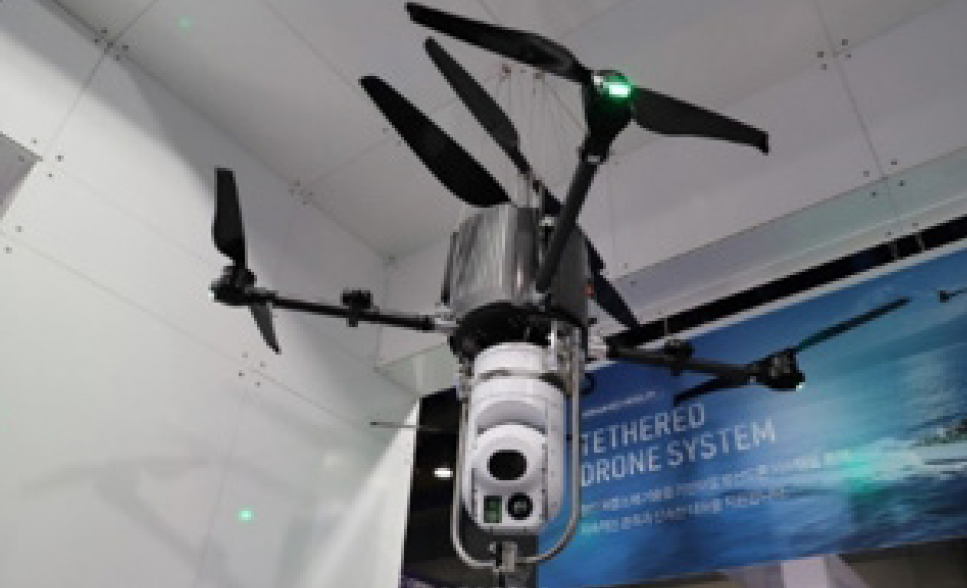
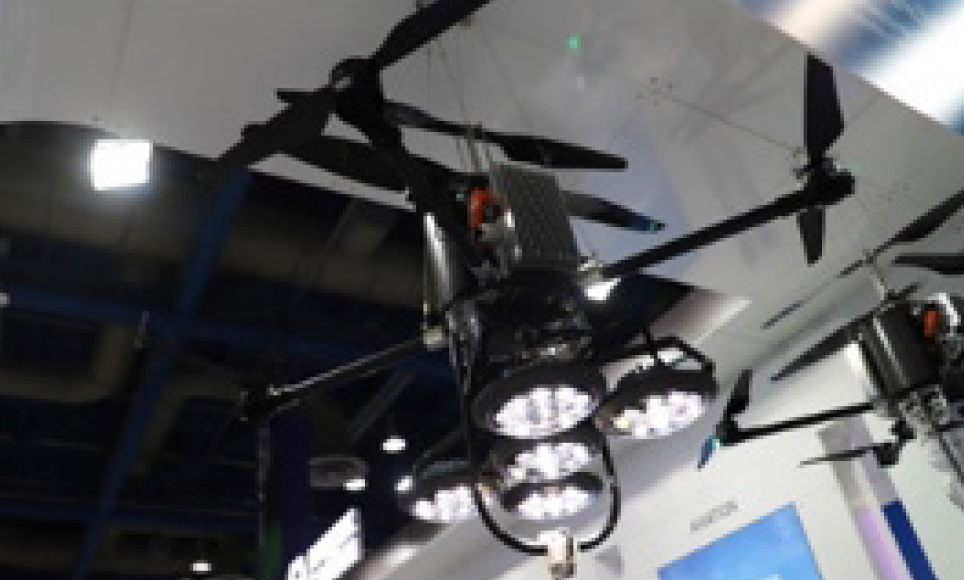
Mission equipment developed to meet the needs of the Korea Coast Guard was also introduced at this exhibition. The EO/IR Camera System, which integrates thermal imaging, 4K cameras, and rangefinders, was specially designed for use on the Coast Guard’s vessel tracking missions. The lighting equipment, intended to assist in search operations at night, utilizes products from a U.S.-led company and is designed to provide an illumination level of 180,000 to 200,000 lux.
A spokesperson for the company explained, “Lightweighting using composite materials and proprietary design technology are our competitive advantages. We are predicting demand in various fields requiring long flight endurance, including reconnaissance and surveillance by the Coast Guard and military — as well as for monitoring wildfires, disaster sites, and construction sites. We have completed actual flight tests up to the maximum allowable altitude of 150m under current regulations and 10 hours of continuous flight. In the future, our goal is to develop a drone capable of continuous flight at an altitude of 300m by incorporating a 400v motor to reduce the weight of the regulator.”
korean-electronics.com | Blog Magazine of korean electronics, brands and Goods