Digital wireless communication solution (transceiver)

[INQ. NO. 1406E03] https://korean-electronics.com//inquirySeyoung Information & Telecommunication recently began promoting its latest hot item model WIWI(SH-320). It is a 2.4GHz digital transceiver for wireless communication. Simultaneous two-way voice communication is supported.

Four-channel use is available for concurrent communication among three persons in maximum per channel and the audio receiving is possible by adding another 255persons.It only weighs 39g, and it has comparative advantages in carrying over similar to those of competitor companies. This can be used while being carried. And in addition to providing voice and audio data communication, it even supports high-security communication.
1406E03

Designed to be linked with audio devices including TV, PC, MP3, Speaker, etc., WIWI’s application territories are now extending into various fields including tour guide, industrial field, broadcasting, riding horse, business meetings, etc.

This product ensures at least 8~12 hours of operation time, only requiring 2hours of charging time.

An option product Dongle(UD-110) is also ready for seeking users all over the world, with some impressive features including support of bi-directional audio function when it is connected to other multimedia with USB cable. The acoustic source is audible from multimedia via SH-320, and its voice inputs to the computer via SH-320 mic.

Since it was spun off from the Network Business Unit of Samsung Electronics in 1998, the company has steadily expanded its business area as a professional repairing company. The repairing area has now grown to cover highspeed terminals and CDMA vase station equipment based on its repairing technique in the exchanger area.

Seyoung aggressively copes with demand of the future and keeps pace with rapidly changing technology and customers’ requirements, based on the complete quality management, innovative management and experienced experts.


korean-electronics.com | Blog Magazine of korean electronics, brands and Goods
High-quality optical components

[INQ. NO. 1406E01] Since 1997, Korea Optron Corporation, as an ISO9001/ISO14001,TL-9000 and UL approved company, has been a market leader in the field of fiber optics.

This optical component specialist has the most advanced facilities and production lines to provide high-quality optical components such as field assembly optical connectors, MPO products optical
patch cords, optical attenuators, PLC splitters, parallel VCSEL transceivers, optical coupler, WDM, and so on. KOC’s excellent FAOC and Optical Attenuators have been recognized as “Korean World-
Class Products” by the Korean government.
https://korean-electronics.com//inquiryIn addition, it has been supplying FAOCs and attenuators to Korea Telecom, SK Broadband and Samsung Fiber Optic as their first vendors and exporting all over the world.

Based on KOC’s rich resources of human knowledge and experience, it has developed new MPO products with Korea Telecom and continue to make efforts to satisfy our customers with high value-added products in the field of fiber optics.

1406E01_1

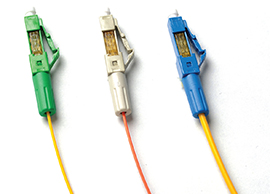
Korea Optron’s Field Assembly Optical Connector (FAOC) is the most widely used fiber optic connector in FTTx that does not need epoxy or polishing.

An SC-type FAOC is the most widely used fiber optic connector in FTTx that does not need epoxy or polishing.

It enables fast and on-site installation of 250μm, 900μm, 3.0mm and 2.0mm x 3.0mm cable type connectors even when the user has no access to power.

An LC type FAOC is a pre-polished and pre-assembled connector that holds a fiber in place and can be installed within two minutes. The LC type is a small design with great details and high technology.

All the parts are made from Ultem material to withstand high temperature and external shocks. It is available in several configurations to fit many different applications for single-mode, multi-mode and APC applications.

1406E01_2

The APC connector is designed to provide superior return loss without sacrificing insertion loss.

An ST type FAOC is the most widely used fi ber optic connector in FTTx that does not need epoxy or polishing. The preassemble and factory terminated connectors can be installed within 2 minutes using simple tools and can be recycled several times.

The ST type is a small design with great details and high technology. All the parts are made from Ultem material to withstand high temperature and external shocks.

It is available in several confi gurations to fit many different applications for singlemode, multimode and APC applications. The APC connector is designed to provide superior return loss without sacrificing insertion loss.

The company’s fiber optic attenuator is used to weaken optical power at a certain level and it is an ideal solution for regulating the power. In addition to variable attenuators, KOC provides plug, in-line and patch cord type attenuators for fixed attenuators.

For the plug type, there are SC, FC, LC, ST and MU packages which can be used directly to the fiber patch cord with adapters the other side. The attenuated patch cords have been provided as SC, ST, FC, LC, MU and hybrid types that can replace the conventional fixed attenuator combinations.


korean-electronics.com | Blog Magazine of korean electronics, brands and Goods
SEMI Reports 2013 Global Semiconductor Equipment Sales of $31.6 Billion

SEMI, the global industry association for companies that supply manufacturing technology and materials to the world’s chip makers, recently reported that worldwide sales of semiconductor manufacturing equipment totaled $31.58 billion in 2013, representing a year-over-year decrease of 14 percent. The data is available in the Worldwide Semiconductor Equipment Market Statistics (SEMS) Report, now available from SEMI.

Compiled from data submitted by members of SEMI and the Semiconductor Equipment Association of Japan (SEAJ), the Worldwide SEMS Report is a summary of the monthly billings and bookings figures for the global semiconductor equipment industry.

The report, which includes data for seven major semiconductor producing regions and 24 product categories, shows worldwide billings totaled $31.58 billion in 2013, compared to $36.93 billion in sales posted in 2012. Categories cover wafer processing, assembly and packaging, test, and other front-end equipment. Other front-end includes mask/reticle manufacturing, wafer manufacturing, and fab facilities equipment.

Spending rates declined for all the regions tracked in the WWSEMS report, except for China and Taiwan. For the second year in a row Taiwan remained the region with the highest amount of spending with $10.57 billion in equipment sales. The North American market surpassed South Korea to claim the second place with $5.26 billion in sales; South Korea fell to the third position with a regional decrease of 41 percent.

The global other front end equipment segment decreased 34 percent; the assembly and packaging segment decreased 26 percent; total test equipment sales decreased 24 percent; and the wafer processing equipment market segment decreased 11 percent.

pyo


korean-electronics.com | Blog Magazine of korean electronics, brands and Goods
A New Competitive Race for Smartwatch

According to recent industry reports, competition for dominance of the smart devices market has shifted to smartwatches. LG Electronics recently announced that it plans to release its first smartwatch powered by Android Wear, Google’s wearables platform, in the second quarter of this year. While the company did not cast a hint about the release date, it will likely be launched in June.

The “G Watch” is an outcome of close collaboration between Google and LG Electronics from the initial stage of development. For the product, the stressed point is on how to elevate the hardware functions to the perfect level, which is optimized for the Android platform. The device is compatible with Android-powered smartphones and users will also be able to access all kinds of information using the “OK Google” command.

A representative, who heads the company’s mobile business, said this collaboration with Google is an opportunity for LG to promote its design and engineering capacity in the wearable market.

The noticeable thing about the G Watch is that Google’s core services have been transferred to a wristwatch. Recent reports have suggested that the watch will be built around “Google Now,” the company’s context-driven personal assistant software. The watch’s powerful voice recognition function is expected to allow the wearer to initiate voice commands to find the remaining flight time, game score, send messages, set alarm or track fitness activity by simply speaking “OK Google.”


S. Korea’s PV Industry to See Growth again

South Korea’s second largest polysilicon producer Hankook Silicon with its annual polysilicon production capacity of 15,000 tons resumed its operations in February. The maker has stopped the whole operations since December 2012 when the international polysilicon prices dropped to $15 per kg.

Meanwhile, Hanwha Chemical finished construction of a 10,000-ton-capacity polysilicon plant in Yeosu late last year and is scheduled to begin commercial production within the first half of this year. Another polysilicon producer Samsung Fine Chemicals is building 10,000-ton-capacity plant in Ulsan and will likely set foot in the market within this year.

The nation’s photovoltaic(PV) industry has been turning around since late last year after being mired in the prolonged slump for over two years. Polysilicon prices climbed for six consecutive weeks after the second week of December to $20.71 per kg as of January 15, according to the PV industry market researcher PV Insight. It marks the first time for the prices to hover above $20 in 16 months since September 2012.

The photovoltaic manufactures which use polysilicon products are also boosting their operating ratios. The nation’s ingot and wafer manufacturer Nexolon is running the entire production lines from late last year while cell manufacturer Hanwha Q.CELLS and module manufacturer Hanwha SolarOne also increased their operating ratios up to 90 percent.

The photovoltaic industry’s return to the path of growth largely came as the demand has picked up speed in the US, China and Japan while expansion of new facilities shrank over the last two years.

The global PV installations hit 35gigawatt(GW) last year, but the number will likely grow to 42 and 50 GW at the maximum level this year.


S. Koran Gov’t to Inject $190mn into Semiconductor, display panel R&D

The South Korean government is set to invest 203 billion won($188million) this year in semiconductor and display research&development(R&D)activities. The plan aims to give a further boost to the nation’s semiconductor industry which outpaced its Japanese counterpart to gain the world’s second biggest semiconductor market share after the US. In addition, the government is to widen the gap between other rivals from neighboring nations like China.

The Ministry of Trade, Industry and Energy recently announced its plan through a recent business briefing held at the Korea Semiconductor Industry Association in Pangyo, Gyeonggi-do that it would spend 203 billion won in R&D work for the semiconductor and display industry. The amount is up four percent from a year ago. 120.9 billion won was earmarked for the semiconductor industry, display panel industry 73.3 billion won and short-term R&D efforts 8.9 billion won.

The nation outpaced Japan last year to grab the second largest global semiconductor market share for the first time.

Korea’s semiconductor industry, however, has so far centered only on memory chips and is weak in equipment and materials. Thereupon, Korea needs to build stronger momentum to address this problem, the government believed. Korea commands an overwhelming 52.4 percent share in the global memory chip market, but takes a mere 5.8 percent share in system semiconductor and 12.5 percent in relevant equipment.

Korea’s display panel industry which has remained top dog for 11 consecutive years in the world saw its global market share edge down from 46.4 percent in 2011 to 45.9percent last year.

So, the government as a measure against this problematic situation allocated 68.2billion won to develop new semiconductor/display panel equipment and materials. Additionally, 49.1 billion won and 18.6 billion won will be used to localize system semiconductor and expand workforce/infrastructure of semiconductors and displays panels, each.


Electronics Industry Faces Sluggish Sales of Mobiles, TVs, and PCs

The global sales of PCs fell 11.1 percent year-on-year(yoy) to $194.9billion last year from $219.2 billion of 2012, and the sales are projected to decline another 5.3 percent to $184.5 billion this year, according to market consultancy IHS.

The sales of mobile devices increased 22.0 percent yoy to $310.1billion last year from $254.1billion a year ago, but the sales are expected to rise only 9.5 percent to $339.4billion.

Even the market of mobile devices such as smartphones, which sparked the second boom in the IT sector, has matured earlier than expected and further growth will be limited, according to analysis.

In response to such change, Samsung Electronics tightened management at the company-wide level by lowering unit cost of parts supplied by subsidiaries and subcontractors and cutting operation and marketing expenses. And LG Electronics, which once lost the very timing for itself to do smartphone business in 209 and thus has been struggling for five years, is also stepping up emergency management.


korean-electronics.com | Blog Magazine of korean electronics, brands and Goods

FTA Negotiations between Korea and Canada Successfully Concluded after Nine Years

The FTA negotiations between South Korea and Canada have finally concluded after nearly nine years of negotiation between the two parties. The two countries’ presidents announced the conclusion of the FTA negotiations following a summit held last month in Korea and further exchanged opinions over issues worthy of cooperation between the two nations, as well as the Northeast Asian regional situation.

A spokesperson of the Ministry of Trade Industry and Energy (MOTIE) said Canada will have to remove tariffs on 93.2% of imported Korean-made products within three years while Korea also must eliminate tariff for 86.1% of imported Canadian-made items in the same period according to the agreement.

For the FTA, in Korea, the automotive sector is expected to see the greatest benefit as export tariffs (6.1%) to Canada will be wholly removed after 24 months from the effectuation of the FTA. The current 6~7% level of tariffs in the areas of automotive components, tires, textiles, etc. would mostly be removed within three years.

However, Korean beef and pork farmers are expected to face more competition as tariff removals of Canadian beef and pork will have to be carried out in 15 years and 13 years, respectively. Korea’s president made her expectation over the FTA by saying, “We expect stronger economic cooperation between the two nations through the South Korea-Canada FTA. Now we officially ask for the sincere support from the Canadian government in the our nation’s participation of the Trans-Pacific Partnership (TPP) based on the fact that Korea’sparticipation in the pact is forecast to facilitate greater trade and investment between Korea and Canada.”
 
 
Significance and Results of the Korea-U.S. FTA

In the past two years since the implementation of the Korea-U.S. (Korus) FTA, exports to the United States and U.S. investment in South Korea have increased, stimulating the Korean economy.

Korea’s exports to the United States have surged and U.S. investment into Korea has been stimulated since the Korea-U.S. FTA took effect two years ago. The United States accounts for 22.5% ($16.2 trillion in 2013) of the global GDP (IMF). It is the world’s largest market, and Korea’s third-largest trading partner.
Since the FTA took office, both exports and imports of products that benefited under the pact have increased and U.S. investment in Korea have surged, stimulating Korea’s economy.

Korea-U.S. trade volume rose by 4.1% ($197.4B- >$205.4B) following the implementation of the KORUS FTA. In the second year of the FTA, the trade volume of the products that benefited under the pact rose by 13.0% ($41.7B->$47.1B), but the trade volume of the products that were excluded from the agreement was down by 8.6%.

Since the FTA took effect, Korea’s exports to the United States have grown faster than total exports, which have meant that the agreement has served as a sustaining pillar for exporters here. Exports of products included in the FTA grew for two consecutive years (1st year 1.6%->2nd year 5.4%), with continuous growth in automobile parts (11.5- >8.3%) and petroleum products (36.1->5.9%).

However, the growth rate in those sectors dropped sharply due to falling export prices and the extension of overseas oil refinery facilities. Exports of excluded items decreased (-3.5%) during the first year of the FTA, but went up in the second year (5.7%). Exports of wireless communication devices plunged during the first year of the FTA (-34.1%) only to go up again during the second year (31.3%), thanks largely to a boom in the LTE market.

Exports of automobiles rose (16.5->14.7%) over the two years, due to improved quality and brand awareness.

Over the two years since the FTA went into effect, imports of U.S. goods increased(10.1%), mostly in products included in the pact, which partially offset the decrease in the import of products excluded from the pact (-23.8%). Imports of items included in the pact such as prime mover and pumps (-4.4->9.7%) and agricultural chemicals and medicine & medical supplies (15.9->13.4%) were steadily increased (5.3- >4.5%), while imports of excluded items fell (-20.7->-3.7%) for two straight years due to weak imports in the semiconductor (-1.3-.-6.1%) and aircraft & parts (-16.3->-12.9%) sectors. The use ratio of the Korus FTA in exports during the second year stood at 75.7%, up from the first year.


korean-electronics.com | Blog Magazine of korean electronics, brands and Goods

Korea’s Trade Surplus in ICT is on the rise thanks to Advanced . Emerging Economies’ Increase in ICT Production Exports

Exports reached 12.84 billion (up 8.4%) while imports were recorded as USD 6.21 billion (up 13.5%), resulting in a trade surplus of USD 6.63 billion.

Korea’s ICT product exports in February 2014 were recorded as USD 12.84 billion, up by 8.4% compared to the same period in the previous year. Korea’s ICT product exports increased evenly in the advanced and emerging countries based on export restoration in the U.S., European countries and Japan, as well as export expansion to ASEAN – Latin American countries.

By region, ITC product exports to the U.S. increased to USD 1.12 billion, up by 7.9%, while those to EU countries, Japan, ASEAN countries, and Latin American countries were recorded as USD 1.34 billion (up 1.9%), USD 0.53 billion (up by 19.7%), USD 1.65 billion (up 5.4%), and USD 0.76 billion (up 8.3%), respectively.

By item, mobile phones (USD 2.05 billion, up 37.7%), semiconductors (USD 4.47 billion, up 14.6%) and D-TVs (USD 0.53 billion, up 8.6%) all continued to lead the increase in exports.

Production ExportsKorea’s ICT industry was in the black, recording a surplus of USD 6.63 billion, which served as a driving force to reach the nation’s trade surplus of USD 0.93 billion for the month. ICT product export performance and trade balance in February in recent years are shown in the figure below.

Overall imports of ICT products were recorded as USD 6.21 billion in February, up by 13.5% compared to the same period in the previous year. By item, imports of semiconductors (USD 2.59 billion, up 11.2%) and display panels (USD 0.42 billion, up 0.5%), and D-TVs (USD 0. 2 billion, up 21.7%), while imports of computers (USD 0.25 billion, down 8.7%) declined.

By region, imports from most countries such as China (including Hong Kong, USD 2.16 billion, up 15.6%), ASEAN countries (USD 1.01 billion, up 27.2%), the U.S. (USD 0.6 billion, up by 5.4%) and EU countries (USD 0.46, up by 9.7%) increased.

As well, it is expected that ICT product exports will remain strong mainly with restoration in the world ICT markets and growth of major items such as Smartphones, and semiconductors.
 

Seoul’s Export Similarity with Tokyo Touches Record Last Year

South Korea’s export similarity index(ESI) against Japan hit record last year. The ESIs were especially high for Korea’s major export items such as car and car parts, machinery and electronics. Once the weaker yen backed by the Abenomics starts to have a full impact, the export competition between the two countries would likely heat up further.

Korea’s ESI with Japan reached 0.501 last year, surpassing the 0.5 mark for the first time, said the Korea International Trade Association(KITA) recently.

The ESI quantifies the similarity of export product composition to gauge the competition among countries in foreign markets. The closer to one the reading is, the fiercer the competition is.

“A reading over 0.5 between Korea and Japan suggests at least 50 percent of the two countries’ export products are similar,” said Chang Sang-sik, a researcher at the Institute for International Trade under the KITA.

Considering the ESI with the world’s top trading country China stood at 0.377 last year, Korea’s gauge with Japan particularly stands out.

The index confirmed that even though several of Japan’s industries are losing competitiveness, the country is still Korea’s biggest competitor in the export market. By product, the ESI with Japan in auto parts, one of Korea’s top seven exports, came to a record 0.560.
 

Simplified Customs Procedures to Facilitate Direct Overseas Purchases

In order for the growing number of South Koreans seeking to purchase overseas products directly online, the Korea Customs Office is set to simplify related customs procedures.

Trading through direct purchases using special delivery services, international mail, or purchase agents stood at $1 billion, or 11 million cases, according to the KCO.

In 2011 and 2012, the figures were $470 million or 5.6 million cases and $700 million or 8 million cases, respectively, showing trading over the Internet has grown 113 percent in just two years in financial terms and 96 percent in terms of the number of transactions.

As direct purchases not only offer convenience to local customers but have the effect of bringing down prices at shops selling overseas products within the country, the organization will expand the number of items subject to tax exemption from the current six to ten. Such items which are imported for personal use and are priced at below $200 are exempted from customs tax.

Now, six items (clothing, shoes, toilet paper, kitchen utensils, printed materials, and luminaries) are exempted from customs tax but the organization plans to add four additional items of toys & dolls, electronics goods, fitness equipment, and accessories to the list within this year.

In addition to the simplification of the customs procedures, the organization is also considering relaxing requirements for a specially designated purchasing agent, which enjoys simple customs procedures and other benefits, from the current 100 million won ($93,005) in capitalization and more than 100 declaration records per month to 50 million won in capitalization and more than 50 declaration records per month.


korean-electronics.com | Blog Magazine of korean electronics, brands and Goods

Document Protection Solutions

President John Choihttps://korean-electronics.com//inquiry[INQ. NO. 1404E47]Since 1999, MarkAny has led DRM and Watermarking Technology and has been providing solutions for internal security, media content security and forgery prevention for online ecertificates.

MarkAny has indepth knowledge and technical expertise, and provides the most experienced and highly qualified consultants. MarkAny is highly reputable and possesses profound technical references in the proposed security area. It has established around 700 reference sites across every industrial sector, covering the public, financial, manufacturing, communications, and online services in Korea and overseas over the past decade.

MarkAny boasts the world’s leading DRM and watermarking technology and has applied for 250 patents at home and abroad and already has 110 registered patents. The watermarking technology, in particular, was designated as Korea’s core technology. The company’s key products are Document SAFER™, e-Page SAFER™, Content SAFER™, and watermarking applications.

Document SAFER™ is a technology that prevents the leakage of confidential internal information, such as classified documents, key technologies, design drawings and customer information. By title and job, authorized access differs. You may only be able to read while others may have the authority to print, save or edit.
Any unauthorized user cannot have access to the document at all.

Surprisingly, 90% of the leakage is by internal users, not by hackers or someone from the outside. Because Document SAFER™ encrypts the documents, the unauthorized users cannot open or read the documents, even if they copy the files to a thumb drive or send out via email.

Even if the documents are printed, the information of the person who printed is hidden in the document, making it easier to track who printed what and where. This will also keep the users wary and think twice before printing.

There are other features as well. You can limit the number of times allowed to read or print the document, or have the document disappear automatically after a set period of time. It means you can manage the internal documents securely. With this trustworthy technology in place, companies will be able to establish a distribution security system, by which they prevent the leakage of any confidential information and win the trust of the customers on the other hand.

Document SAFER to
MarkAny installed its Document SAFER at LG Research Institute in 2001. Since then, it has supplied its Document SAFER to approximately 1,000 sites at home and abroad in all industrial sectors including manufacturing, financial, construction, shipping, distribution, pharmaceuticals, aviation, and steel.

Its client list includes Ximeta of the USA, JustSystem of Japan, ZTE of China, and Korea’s central government agencies, including the Ministry of Foreign Affairs, the Ministry of Justice, the Ministry of Trade Industry and Energy, the Ministry of Unification, the Ministry of Health and Welfare, and so forth.

e-Page SAFER™ is a solution that prevents and verifies the forgery of the certificates and other electronic documents issued online. This is a highly useful solution for businesses and organizations across industries, including the public sector, finance, education, enterprise and many more.

The elements that make this online anti-forgery technology possible are copy protection mark, 2D barcode and watermarks. When the printed document is copied, a copy protection mark is inserted or removed to distinguish a copy from the original.

The 2D barcode is about encrypting and compressing the information of the printed document and inserting it in the 2D barcode. This helps you restore the information about the original document stored in the 2D barcode and track/verify the forgery.

Watermark involves a technology of inserting the logo of the issuer in grayscale in the printed document or hiding the information of the person who printed the document into the logo. This is proven to be effective in verifying the origin of the document.

Wherever there is a computer and a printer, e-Page SAFER™ helps you issue the document you need so as to minimize the user inconvenience of having to go to the relevant office that issues the document. This also helps the public organizations, financial institutions and companies to flexibly make better use of their human resources.

Document SAFER
It was first supplied in 2002 as a solution for electronic civil affairs service at the Gangnam-gu Office. MarkAny exclusively supplied solutions to about 500 companies at home and abroad including government agencies like the National Tax Office, the Supreme Court, and the Korean National Railroad, 20 credit card companies and insurers in Korea, universities, hospitals, associations, general companies, and IPSS of Thailand. As such, MarkAny has realized the service to issue civil documents online as well as the e-government.

Content SAFER™ is a copyright protection solution that ensures that photographs, music, video and other digital contents are safely distributed. Recently, there has been a rise in the servicing of movie, music, eBook and other multimedia contents. If distributed without any protective measures, the contents can spread virally and illegally through the Internet into the hands of unauthorized users. This is a devastating blow to the copyright holder and servicing company.

Content SAFER™ is a distribution security platform for digital content. When a user purchases the content via the online servicing company, they also download the content protected by DRM and license onto their computer.

The billing server connected to the Internet portal site processes the payment made by the user and sends the user and payment information to the license server, which in turn takes the information to issue and manage the license. When the content is illegally distributed to an unauthorized user, the access to and use of the content is blocked. The content servicing company will enjoy this one-stop solution, both wired and wireless, ranging from content creation to the distribution, management and billing.

The company’s content SAFER has been supplied to Verizon, Overdrive and MSI of the U.S., Rogers and Yangaroo of Canada, and FoxConn of Taiwan. In 2009, MarkAny supplied the solutions to the Universal Music Group (UMG), the world’s biggest music label. In Korea, the company has supplied solutions to around 100 domestic and international content service providers. They include public agencies such as the Korean Film Council, the Copyright Protection Center, the Korea Internet & Security Agency, three major telecom operators, device manufacturers like Samsung Electronics and Pantech, educational institutions and online service providers.
Document SAFER2


korean-electronics.com | Blog Magazine of korean electronics, brands and Goods
Windows Embedded 8 Handheld Devices

Handheld Devices
https://korean-electronics.com//inquiry[INQ. NO. 1404E46]Bluebird, a global provider offering full range of enterprise mobile device including data capture, payment and business tablet and handheld devices, today announced the availability of its flagship model, BM180 / BP30. These devices, built on the Microsoft Windows Embedded 8 Handheld platform, aim to be the best in the data capture and payment market place.

Windows Embedded 8 Handheld is the next generation of Microsoft’s leading platform for line-of-business handheld devices. This means that end-users will gain enterprise-grade security and manageability, along with full Windows phone 8 application compatibility, allowing businesses to leverage Microsoft’s enterprise-ready applications such as Dynamics AX, Lync and Office Mobile.

Handheld Devices2Retailers are attempting to manage their stores in the most efficient way through the integration of voice and data communications into one single device. The use of mobile POS terminals has significantly decreased the waiting time at the checkout lines.

Bluebird has proactively addressed this changing environment, starting with their enterprise BM series mobile computer in 2004. Building on this market experience, Bluebird is launching the BM180 / BP30, the first Windows Embedded 8 Handheld devices to be available.

With Windows Embedded 8 Handheld, enterprise users gain development productivity when creating business apps using common application programming interfaces (APIs) to access integrated peripherals in handheld devices.

The same APIs are available in Windows Embedded 8 Standard and Windows Embedded 8 Industry platforms, making it easy to deliver an application on these industry specific handheld devices and then bring that application to fixed point of sale terminals, digital signage, kiosk and other embedded devices.

As well as their Windows based Business tablet – BP80, Bluebird is launching its flagship model, BM180 / BP30, and both are scheduled to be purchased by several major retailers across the U.S.

Handheld Devices3
Although these products are made for enterprise customers, both products offer the most user-friendly features such as the interface, screen size, slim design and compact form factor. With these products, many more will recognize the prime quality of a Windows solution.

Bluebird is a global provider offering full range of enterprise mobile device including data capture, payment and business tablet. It is the only manufacturer who can really focus on both Mobile computing and payment industry at the same time.

Bluebird is a premium supplier who can integrate Windows Embedded 8 Handheld in the market place. Headquartered in Korea, Bluebird operates local offices in
US and China.

Handheld Devices4


korean-electronics.com | Blog Magazine of korean electronics, brands and Goods
Android Business Tablet

Android Business Table2t
https://korean-electronics.com//inquiry[INQ. NO. 1404E45]Looking at the current state of gadgets deployed in the enterprise arena, one can tell whether one edge or the other is missing. For instance, typical smartphones are fragile, and cannot provide the functionalities for various verticals. Handheld computers might be rugged and functional, but the screen size is too small. These tools have been always accompanied by inconvenient handicaps.

Choosing to go different for the better, Bluebird properly mixed the best of each edge on the BP50. Connected to the fastest wireless network, the most productive interactions take place on the premium 7” Eyelluminate™ Display. Flexible combination of smart plugs keeps you on point at all missions and tasks.

With the mastered craft of TankSmith™ reliability, the BP50 welcomes the harshest environments. The level of security is solid like a stone wall. And better yet, the BP50 is designed to be carried.

Android Business TabletThe BP50 has answered the riddle of “How to Show Well?” with Eyelluminate™ Display, Bluebird’s bold innovation for better showing and viewing. The bright IPS panel displays everything in full color schemes from all angles. The 7-inch screen size covers far more contents (as vivid as in real life) than a typical handheld device, and is the right size for mobility.

By closely bonding the cover glass and LCD with gel fluid, the BP50’s display has removed the air-gap that causes reflective glares on the screen surface. The bright sunlight reflection can no longer disturb you from seeing what you need to see, and the anti-fingerprint coating prevents the finger touches from blurring the screen.

Putting all the technical details aside, just remember one thing and one thing only. Even at a glance, everything looks and shows better on the BP50.

Android Business Table3tThe BP50’s performance level simply stands out. The fastest of the fastest dual core processors, orchestrates smooth operation and swift execution at the same time. For instance, as you run heavy applications like constructional blueprints or in-flight manual on the BP50, you will be fascinated by the finesse of these applications. Outperform the rest with the best! The long battery life speaks for the other half of the BP50’s performance.

Empowered by the longest battery hours, the BP50 lasts well beyond a typical full-time shift, and even when you need to switch the batteries, you can do so without upsetting the workflow. During the brief absence of the battery to be switched, the hot-swap function keeps the BP50 on. Use it with a peace of mind.

Android Business Table24The BP50 is designed to be carried, so that you can go out, and reach more future-building opportunities. The BP50 comes in a lighter and compact frame with the hand-strap on the back. Do you happen to answer your call of duties for various field missions? Do you need to bust the queues for your customers in a busy check-out lane? With the BP50, you are good to go without putting any strain on your wrists. All the essentials for mobility are standing by the BP50.
Coming handy and dandy, the BP50 goes where you go; the sky is your only limit with the BP50.

Coming with flexible combinations of smart plugs, the BP50 adjusts itself to your daily tasks. At one scan or two, you can easily manage your warehouse inventory count, or check the product details of your freshest arrivals. All payment schemes from conventional Magnetic Stripe Reader to the future building NFCs are fully supported on the BP50. Help your customers pay however they like to pay. During the busiest hours of your shop, let your customers pay where they stay.

Android Business Table4tBecome the smoothest concierge or the sharpest warehouse manager just to name two. What merely ended as wishful thinking on conventional PDAs has become available and yours on the BP50. Just add, subtract, and use only what you need; the BP50 is always on point. And yes, it will keep your TCO low.

Bluebird’s TankSmith™ has mastered the craft of reliability, and applied it to the BP50. The patented waterproof measure underneath the BP50’s surface has brought about the solid sealing of IP65. Whether you are assigned to gather information from the humid rainforest or dusty desert, you should not have a care.

Combined with this tight sealing, the optional rugged plug enhances the level of drop resistance to 1.5m.

Android Business Table23tBy covering its entire front with Gorilla® Glass, the BP50 has become scratch-immune while acquiring a very prestigious flavor. Engineered to survive all spheres of wilderness, the BP50 is ready for heavy duty.

Staying connected means that everyone stays on the same page at the same time. That is exactly what the BP50 is enabling. Fully supporting VPN and Wi-Fi Protocols, the BP50 securely connects to the corporate intranet; the office can appreciate the seamless workflow. Out of office? Connect the BP50 to the 4G LTE network, the fastest wireless network by far; the BP50 goes all area without compromising the connectivity or the speed.

Android Business Table04tNo longer disturbed by the sporadic disconnections, the field agents and headquarters can share every detail in no time. When needed, conduct high definition video conferences from continent to continent. Stay on the same page via the BP50, and build the future with the most productive interactions.

At each vertical, the demand for value-added applications is very compelling every day. With open S/W platform and familiar UI, the BP50 provides the perfect environment for developing these highly demanded applications; anyone can come up with the most practical solutions to be efficient and productive.

Android Business Table22tAnd this convenient ecosystem for developing value added applications is built upon the BP50’s Stonewall Security™. The airtight level of data encryption blocks out thieves and their futile attempts of intrusion. What if the device gets stolen or lost? The BP50 may be updated, monitored, staged, and if necessary disposed of over the air. Everything is present on the BP50 for you to move forward in your personal and business life.


korean-electronics.com | Blog Magazine of korean electronics, brands and Goods
INSUNG INFORMATION:

Korea’s First Company to Export a Uhealth Software Package to the USA

INSUNGhttps://korean-electronics.com//inquiry[INQ. NO. 1404E44] Korea’s leading company in the field of u-healthcare (telemedicine), Insung Information Co., Ltd., is accelerating its global exports with new momentum.

Following its recent contract worth US$4 million with a French company supplying telemedicine systems (product name: Hicare Home Doctor), Insung Information signed a contract on supplying its telehealth software package (product name: Hicare Smart) to AMC Healthcare.

While the existing Hicare Home Doctor was to provide service through its device, Hicare Smart is a Hicare software solution customized for smartphones and tablets. The ubiquitous healthcare service of Hicare Smart can be accessed by installing it on smartphones and tablets supplied by Verizon Communications in the United States.

U-Health services are designed to measure an individual’s health status such as blood pressure, blood glucose, body fat, oxygen saturation, electronic stethoscope, etc. by using smart devices so as to manage and prevent chronic disease like diabetes and hypertension, and it allows one to have a health consultation at home through a one-on-one video medical consultation without having to go to hospital to get health advice.

Besides blood pressure and blood glucose, it integrates with various medical devices, and supports many features considered essential for users such as voice guidance, measuring/medication alarm, blutooth/USB, wired and wireless Internet.

This is a case where the u-Healthcare service model is expanded to mobile platforms, and it is expected to be adopted to various OS of smart devices (android, iOS). Insung Information is self-developing a uhealthcare solution for smart devices and this time it is not a hardware gateway device, but software to supply what is the first case study in Korea.

In particular, U.S. telecommunications companies like Verizon have recently been launching smart healthcare products and so as the business is based on progress connected to the program, this case of supplying software package to a telecommunication company could be very meaningful. Next year, there would be a new product launch of Hicare Smart Hub (TBD) allowing for u-Healthcare services to be offered by integrating with many types of smart devices and phones, then it is expected to build a full and diversified product lineup, from u-Healthcare hardware to software.

After the successful marketing of its Hicare Smart model, Insung Information is planning to expand its sales to telecommunication companies in Europe, Australia and Asia through existing partners with similar models. And it would be increasingly diversified into a type of Hicare cloud service.

The CEO of Insung Information, Mr. Won Jongyoon said, “This contract of supplying Hicare Smart is a successful case study of showing the potential for spreading u-healthcare business to not only hardware platforms but to software platforms as well.” He continued, “As we diversified and built a full product lineup from hardware to software, we will aggressively continue overseas business by close collaboration with global partners and with a suitable model for each country.”

HicareHome Doctor
Product Details
HicareHome Doctor is a new type of home healthcare device that enables you to easily accumulate and manage various vital sign measurements while allowing you to remotely and effectively obtain advice and support of medical practitioners.

Measurement items:
Body pressure/pulse (built-in), blood glucose (docking type), oxygen saturation, body composition, body temperature, weight, height, etc. (About 40 peripheral devices integrating with main unit)

Other Flagship model
The company’s HicareSmart is a customized application that would be installed on smartphones and tablets. It is a mobile platform software package of supplying telemedicine service, which can measure an individual’s health status such as blood pressure, weight, oxygen saturation, temperature, blood glucose and electronic stethoscope by using this software application together with integrated devices.

It also offers to have health consultation at home through one-on-one video chat function without having to go to hospital to get health advice. HicareSmart supports many features considered for users such as integrating with various devices, photo transfer to server, library, questionnaire, and diary.

Further introduction to the company
The company’s U-Health Division develops medical service platform that can be used conveniently at anywhere anytime by using ubiquitous technology. And also it provides healthcare services that are under multi IT infrastructure.

Through continuous technology development and accomplishment of various projects, in 2010, Insung Information got involved into a consortium named ‘SmartcarePilot Project’ together with Samsung Electronics and SK Telecom which project sized of US$35million, and Insung Information could gain a footehold for dominating the u-Health market.


korean-electronics.com | Blog Magazine of korean electronics, brands and Goods