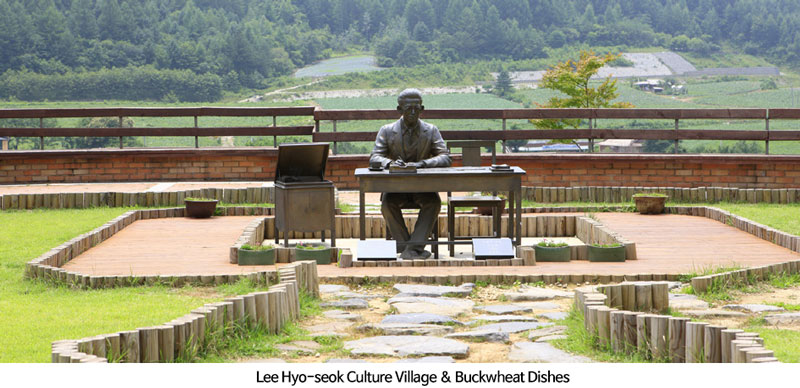
Every autumn, buckwheat flowers blossom throughout Bongpyeong-myeon, Pyeongchang-gun. At the peak of the blooming season, you can enjoy the beautiful and romantic scenery of the snow-white fields of buckwheat flowers in the village. The village is also the setting of well-known Korean author Lee Hyo-seok’s story “When Buckwheat Flowers Bloom,” and thus PyeongchangHyoseok Cultural Festival is held here every September to commemorate the novel.
Even during the non-seasonal period of the buckwheat flowers, Bongpyeong is always ready to serve. Be sure to visit Lee Hyo-seok Memorial Hall or stop by for some memilguksu (buckwheat noodles), memilmuk (buckwheat jelly), or memilkkotsul (buckwheat blossom liquor).
• Address: Lee Hyo-seok Memorial Hall, 75-25, Hyoseokmunhwa-gil, Bongpyeong-myeon, Pyeongchang-gun, Gangwon-do
• Lee Hyo-seok Memorial Hall
- Operating hours: October-April 09:00-17:30, May-September 09:00-18:30 (Last admission 30 minutes before closing) / Closed Mondays, January 1, the day of Seollal (Lunar New Year’s Day) &Chuseok (Korean Thanksgiving Day)
• Admission: Adults 2,000 won / Teenagers 1,500 won / Children 1,000 won
• Website: http://www.hyoseok.org (Korean only)
Discover Korea’s History in Pyeongchang, Jeonggangwon&Woljeongsa Temple
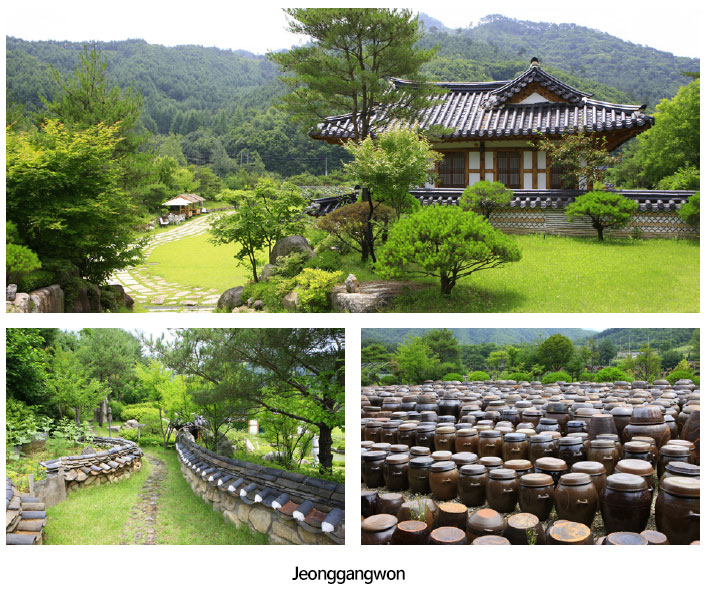
Korea Traditional Food Culture Experience Center, Jeonggangwon
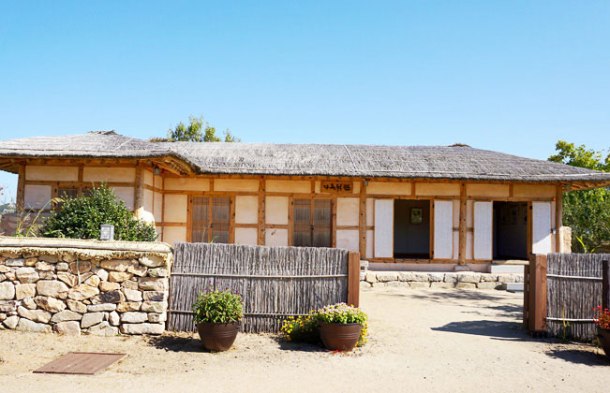
Jeonggangwon (Korea Traditional Food Culture Experience Center) was established in order to preserve, research, distribute and promote the values and merits of traditional Korean food culture to the world. The hanok-style buildings of Jeonggangwon include a food museum, as well as a hanbok experience and cooking lessons. A restaurant that offers traditional hanjeongsik (Korean table d’hôte) is also available. The beautiful hanok buildings, garden, and hundreds of jangdok (traditional Korean crock) gathered together are especially popular among international visitors.
• Address: 2010-13, Geumdanggyegok-ro, Yongpyeong-myeon, Pyeongchang-gun, Gangwon-do
• Operating hours: 09:00-19:00 / Closed the day of Seollal (Lunar New Year’s Day) &Chuseok (Korean Thanksgiving Day)
• Fees: Free admission to Food Museum / Hanbok experience 8,000 won / Separate fees apply for hands-on activities
• Website: http://www.jeonggangwon.com (Korean, English, Japanese, Chinese)
Temple within a forest of fir trees, Woljeongsa Temple
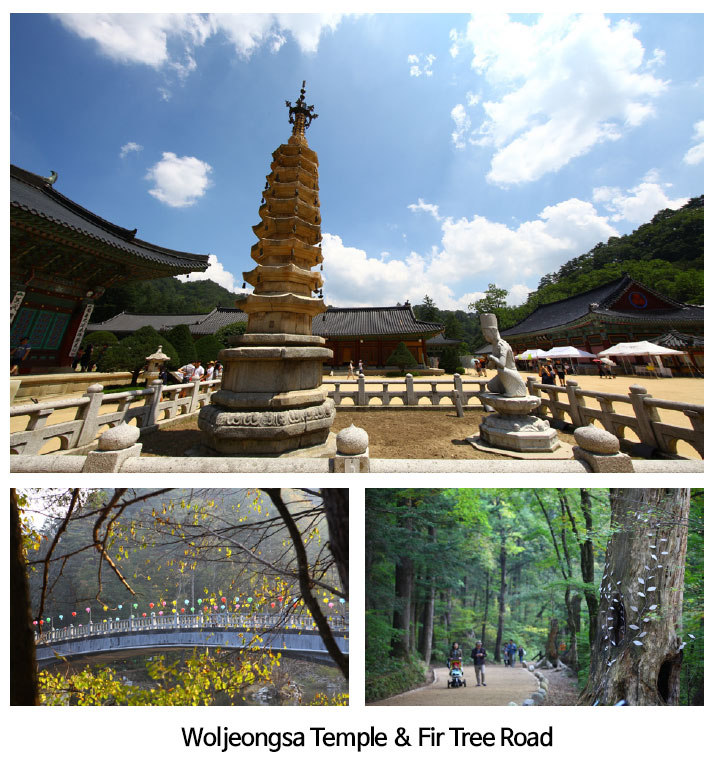
Woljeongsa Temple boasts a history of over one thousand years, making it a proud cultural site in Pyeongchang. Although many cultural assets were destroyed during the Korean War and then later reconstructed, visitors can still sense the strong coexistence of Odaesan Mountain’s nature with Woljeongsa Temple’s dignity and spirit.
Woljeongsa Temple has many national treasures, including the octagonal nine-story stone pagoda. Other national treasures that have been excavated are preserved in Woljeongsa Museum, a definite must-see if you are visiting the temple. From the entrance of Woljeongsa Temple, a separate road leads off to a path through a dense fir tree forest. Not only magnificent in appearance, walking through this pathway filled with fir trees can be equally relaxing and refreshing to one’s mind, making it a popular destination among the locals.
• Address: 374-8, Odaesan-ro, Jinbu-myeon, Pyeongchang-gun, Gangwon-do
• Admission: Adults 3,000 won / Teenagers 1,500 won / Children 500 won
• Website: woljeongsa.org (Korean, English)
More Info
☞ Transportation (Seoul → Pyeongchang)
Dong Seoul Bus Terminal → Pyeongchang Bus Terminal (First bus 07:00, last bus 18:46 / Travel time approx. 2 hrs)
Dong Seoul Bus Terminal → Jangpyeong Bus Stop (First bus 06:35, last bus 20:20 / Travel time approx. 2 hrs)
Dong Seoul Bus Terminal → Hoenggye Intercity Bus Stop (First bus 06:35, last bus 20:20 / Travel time approx. 2 hrs 30 min)
Seoul Nambu Terminal → Jangpyeong Bus Stop (First bus 07:00, last bus 19:20 / Travel time approx. 1 hr 50 min)
Seoul Nambu Terminal → Hoenggye Intercity Bus Stop (First bus 07:00, last bus 19:20 / Travel time approx. 2 hrs 30 min)
☞ Related suggested itineraries
Two Days in the Pure Scenery of Pyeongchang & Jeongseon
Travel Through Gangwon-do’s Scenic Beauty
☞ Pyeongchang Tourism website: tour.pc.go.kr (Korean, English, Japanese, Chinese, German, French)
☞ 1330 Korea Travel Hotline: +82-2-1330 (Korean, English, Japanese, Chinese)
korean-electronics.com | Blog Magazine of korean electronics, brands and Goods

 Setting off for Gapado Island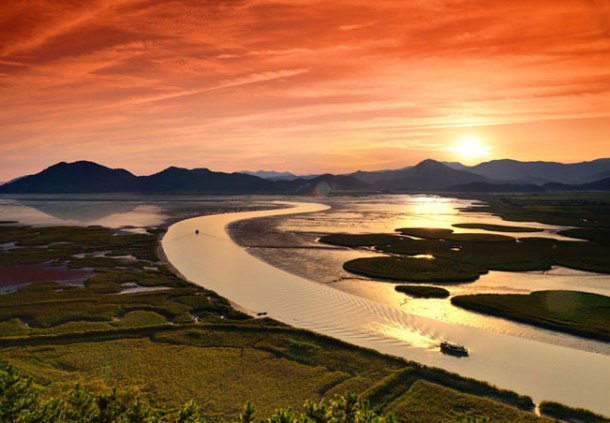
 Suncheon Bay National Garden, opened for the international Suncheon Bay Garden Expo, is the first National Garden in Korea. A wide variety of themed gardens can be found meticulously lined up at the garden. Autumn in particular is lively, with thousands of chrysanthemums in every shade, mirroring the field of reeds in the bay.
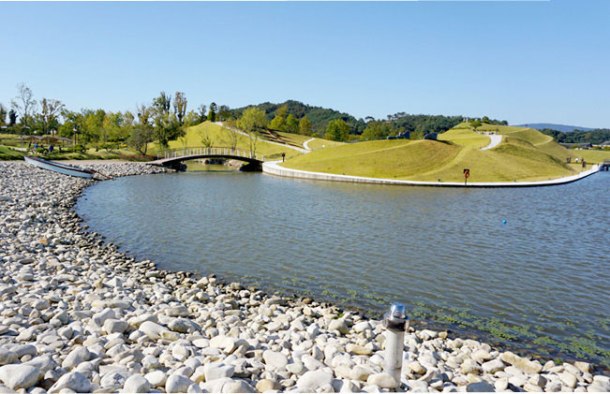 Suncheon Lake Garden was designed by world famous landscape designer Charles Jencks during his stay in Suncheon. This garden displays the city in miniature size, including replicas of the mountains surrounding the city made into smaller hills. In a reversal of elements, the lake in the center of these hills serves as the city of Suncheon, while the wooden deck above represents Dongcheon Stream winding its way through the city. Visitors can stroll along the boardwalk or climb up the hills; the view of Suncheon Lake Garden from the hill peaks is quite stunning.
 The World Garden is made up of garden styles from various countries, including Thailand, Japan, Great Britain, Italy, Turkey, Spain, the United States, the Netherlands, Germany, France, and China. It is an interesting experience to compare and appreciate different aesthetics presented by each nation. The Chinese Garden features a pond and pavilions, while the Turkey Garden represents the culture of the Middle East. The Dutch Garden and French Garden have models of their famous windmills and Palace of Versailles, respectively. Walking through each garden will offer visitors a chance to experience the visual differences in cultures from around the world.
 The Metasequoia Path is the most popular trail at the garden among couples. The trees were originally slated to be cut down in order to expand the highway system, but were moved to the garden to live out the rest of their lives.
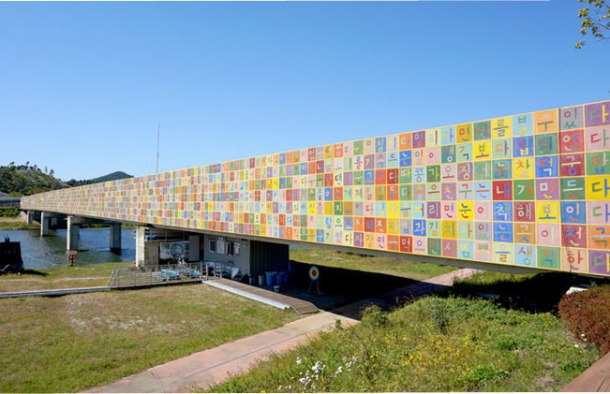 The Dream Bridge, designed by installation artist Kang Ik-joong, was created by reusing 30 container boxes. The walls of the bridge are decorated with more than 140,000 vivid paintings created by children from around the world. All those who cross the bridge can feel a strong desire to protect Suncheonman Bay and the world’s natural environment.
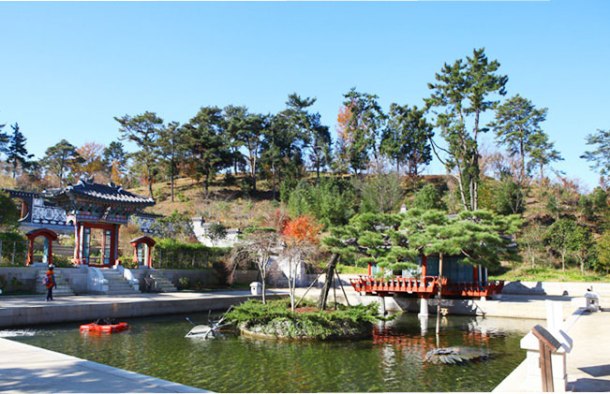 Korean Traditional Garden’s palace garden reproduces the elegant and beautiful Huwon areas of Changdeokgung Palace and Gyeongbokgung Palace. The noblemen’s garden shows a glimpse of the atmosphere in which ancient noblemen relaxed and studied with nature by their side. Lastly, the garden of hope focuses on a motif of folk beliefs. One can see many stone towers, created with the tradition of stacking a stone while making a wish in order for the wish to come true.
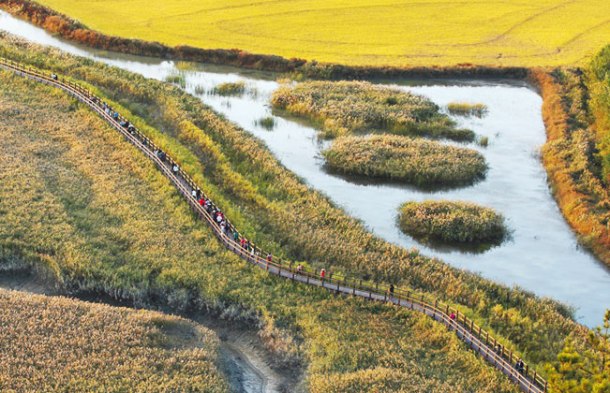 Suncheonman Bay is one of the world’s top five coastal wetlands, and is by far Korea’s most beautiful natural landscape. The seemingly endless field of reeds surrounded on three sides by mountains and open to the sea on the fourth is something not easily seen in the world. Moreover, Suncheonman Bay was registered with the Ramsar Convention on Wetlands in January 2006. The wetland serves as home to an array of migratory birds including species like hooded crane, Saunders’s gull and more.
 As soon as you enter the main gate of Suncheonman Bay Wetland Reserve, green lawns and ponds greet you before reaching the reed fields. As soon as you cross Mujingyo Bridge, your journey through the dancing fields of reeds begins. It takes approximately 40 minutes to walk along the path until you reach Yongsan Observatory. Relaxing views of vast fields and picturesque landscapes accompany you throughout your journey.
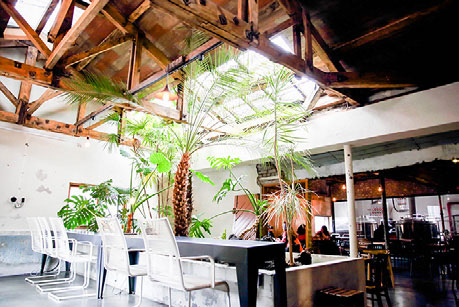 Newcomers to Budnamu Brewery are recommended to try out Budnamu Sampler as the menu consists of the brewery’s four signature beers – Minori Session, Zeumeu Blanc, Pine City Pale Ale, and Ojuck Stout. Minori Session is characterized by a refreshing mandarin-scented aftertaste and Zeumeu Blanc by its smooth wheat flavor followed by a hint of chrysanthemum and Chinese pepper. On the other hand, Pine City Pale Ale offers a bitter but refreshing taste, while the dark Ojuck Stout is bold in both flavor and alcohol content. Budnamu Brewery offers several side menus to go with the beer, but we recommend Budnamu Platter for a taste of the various choices, including cheese, nachos, olives, croquette, and chili.
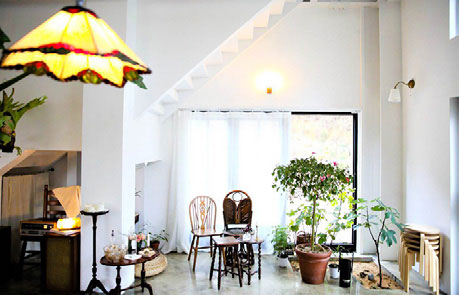 Taking a photo of Wanda Mansion’s desserts is a must as they look just as charming as the café’s interior. Their appearance will delight you even before you take your first bite. Homemade sweet fruit ades are available regardless of season, but a warm latte or cup of strongly blended flat white will melt away the winter cold. Add a rich chocolate brownie to complete your perfect afternoon.
 Bonbon Roastery can be characterized by its sincerity. The fragrance of carefully roasted beans fills the air, tickling your nose. Coffee lovers will be pleased with the diverse coffee options to choose from. If you’re not a fan of coffee, other beverages are also available, such as the house special lemon grape bonbon, presenting a sweet refreshing taste to recharge your energy, or the misutgaru (powder mixture of roasted grains) drink with honey to make for a filling meal in a cup.
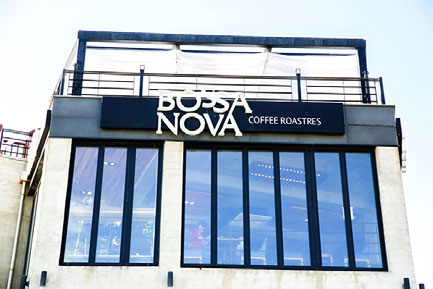 The breathtaking view of the vast ocean is not the only significance Bossa Nova has to offer – the café’s true value lies in their outstanding coffee. Only the most exceptional coffee beans are carefully selected on a seasonal basis and prepared to bring out flavors as superb as the rooftop’s view. The café opens early morning, offering fresh croissants and warm coffee to start the day. Other beverages beside coffees are also available so don’t forget to include Bossa Nova into your itinerary.
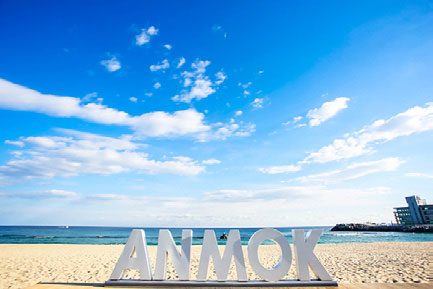 Swings just the right size for two people can be found along the sandy beach, perfect for taking in the ocean view as you share body warmth with someone special. The swings especially serve as a romantic photo spot for couples along with the open beach as a wonderful backdrop. Another way to enjoy winter at Anmok Beach is to take in the ocean view with a hot cup of coffee from the nearby coffee vending machine. The sweet instant coffee is readily available at only 400 won per cup, so don’t forget to prepare some coins in advance.
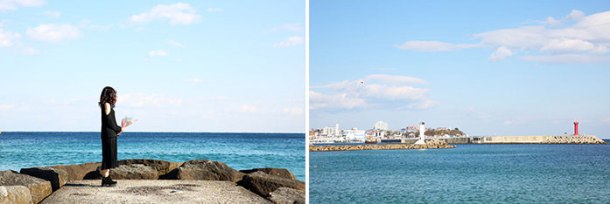 Jumunjin Port consists of a huge hoe center where visitors can enjoy hoe menus at a reasonable price. Other attractions are also available near the port, such as the Jumunjin Beach and Jumunjin Lighthouse.

 Located in the heart of Seoul, Insa-dong Street is one of the most memorable attractions in Seoul and represents the focal point of Korean traditional culture and crafts. Stores in Insa-dong specialize in a wide variety of goods that can only be purchased or appreciated in Korea: hanbok (traditional clothing), hanji (traditional paper), traditional teas, pottery, and folk crafts.


 Hwaseong Fortress was constructed under the guidance of Yu Hyeong-Won (1622-1673) and Jeong Yak-Yong (1762-1836), and is believed to have been constructed very scientifically. The fortress wall was built using Seokjae and Jeondol (bricks) and the holes between the bricks are just big enough to fire guns, arrows, or long spears through in case of an attack.