Korea’s Trade Surplus in ICT is on the rise thanks to Advanced . Emerging Economies’ Increase in ICT Production Exports

Exports reached 12.84 billion (up 8.4%) while imports were recorded as USD 6.21 billion (up 13.5%), resulting in a trade surplus of USD 6.63 billion.

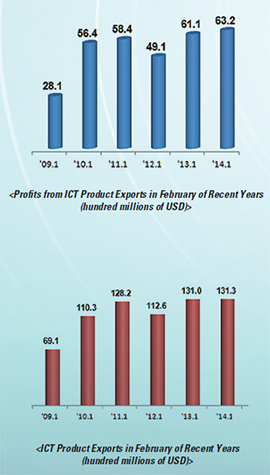
Korea’s ICT product exports in February 2014 were recorded as USD 12.84 billion, up by 8.4% compared to the same period in the previous year. Korea’s ICT product exports increased evenly in the advanced and emerging countries based on export restoration in the U.S., European countries and Japan, as well as export expansion to ASEAN – Latin American countries.

By region, ITC product exports to the U.S. increased to USD 1.12 billion, up by 7.9%, while those to EU countries, Japan, ASEAN countries, and Latin American countries were recorded as USD 1.34 billion (up 1.9%), USD 0.53 billion (up by 19.7%), USD 1.65 billion (up 5.4%), and USD 0.76 billion (up 8.3%), respectively.

By item, mobile phones (USD 2.05 billion, up 37.7%), semiconductors (USD 4.47 billion, up 14.6%) and D-TVs (USD 0.53 billion, up 8.6%) all continued to lead the increase in exports.

Production ExportsKorea’s ICT industry was in the black, recording a surplus of USD 6.63 billion, which served as a driving force to reach the nation’s trade surplus of USD 0.93 billion for the month. ICT product export performance and trade balance in February in recent years are shown in the figure below.

Overall imports of ICT products were recorded as USD 6.21 billion in February, up by 13.5% compared to the same period in the previous year. By item, imports of semiconductors (USD 2.59 billion, up 11.2%) and display panels (USD 0.42 billion, up 0.5%), and D-TVs (USD 0. 2 billion, up 21.7%), while imports of computers (USD 0.25 billion, down 8.7%) declined.

By region, imports from most countries such as China (including Hong Kong, USD 2.16 billion, up 15.6%), ASEAN countries (USD 1.01 billion, up 27.2%), the U.S. (USD 0.6 billion, up by 5.4%) and EU countries (USD 0.46, up by 9.7%) increased.

As well, it is expected that ICT product exports will remain strong mainly with restoration in the world ICT markets and growth of major items such as Smartphones, and semiconductors.
 

Seoul’s Export Similarity with Tokyo Touches Record Last Year

South Korea’s export similarity index(ESI) against Japan hit record last year. The ESIs were especially high for Korea’s major export items such as car and car parts, machinery and electronics. Once the weaker yen backed by the Abenomics starts to have a full impact, the export competition between the two countries would likely heat up further.

Korea’s ESI with Japan reached 0.501 last year, surpassing the 0.5 mark for the first time, said the Korea International Trade Association(KITA) recently.

The ESI quantifies the similarity of export product composition to gauge the competition among countries in foreign markets. The closer to one the reading is, the fiercer the competition is.

“A reading over 0.5 between Korea and Japan suggests at least 50 percent of the two countries’ export products are similar,” said Chang Sang-sik, a researcher at the Institute for International Trade under the KITA.

Considering the ESI with the world’s top trading country China stood at 0.377 last year, Korea’s gauge with Japan particularly stands out.

The index confirmed that even though several of Japan’s industries are losing competitiveness, the country is still Korea’s biggest competitor in the export market. By product, the ESI with Japan in auto parts, one of Korea’s top seven exports, came to a record 0.560.
 

Simplified Customs Procedures to Facilitate Direct Overseas Purchases

In order for the growing number of South Koreans seeking to purchase overseas products directly online, the Korea Customs Office is set to simplify related customs procedures.

Trading through direct purchases using special delivery services, international mail, or purchase agents stood at $1 billion, or 11 million cases, according to the KCO.

In 2011 and 2012, the figures were $470 million or 5.6 million cases and $700 million or 8 million cases, respectively, showing trading over the Internet has grown 113 percent in just two years in financial terms and 96 percent in terms of the number of transactions.

As direct purchases not only offer convenience to local customers but have the effect of bringing down prices at shops selling overseas products within the country, the organization will expand the number of items subject to tax exemption from the current six to ten. Such items which are imported for personal use and are priced at below $200 are exempted from customs tax.

Now, six items (clothing, shoes, toilet paper, kitchen utensils, printed materials, and luminaries) are exempted from customs tax but the organization plans to add four additional items of toys & dolls, electronics goods, fitness equipment, and accessories to the list within this year.

In addition to the simplification of the customs procedures, the organization is also considering relaxing requirements for a specially designated purchasing agent, which enjoys simple customs procedures and other benefits, from the current 100 million won ($93,005) in capitalization and more than 100 declaration records per month to 50 million won in capitalization and more than 50 declaration records per month.


korean-electronics.com | Blog Magazine of korean electronics, brands and Goods

Korea’s Export Prices Hit the Lowest Level Since 2008

Korea’s export and import prices all dropped for two consecutive months on account of the decline of exchange rate and the weaker raw material prices. The export prices declined to the lowest level in five years and eight months, prompting concerns over deteriorating profitability of export companies.

The export price index for October reached 91.21 (base level of 100 in 2010), down 1.9% from the prior month of this year, the lowest level since in February 2008 (89.07). When compared to the export prices index a year before, 4.6% is declined, according to the Bank of Korea (BOK).

In general, a rise in export prices has a positive impact on the profitability of companies, but a decline in export prices negatively affects companies’ profitability. An official from the BOK explained “Export prices for October declined 1.9% month-onmonth (mom) on sliding won/dollars rates.”

The won rose 1.9% from 1,087.35 per dollar in September this year to 1,066.80 in October. By product, agricultural and fishery products climbed 2.6% mom including marine products while industrial goods fell 1.9% mom including chemical and primary metal products.


By Kim Min-su : Here

Samsung Mass-Produces DDR4 Modules

back

Samsung Electronics will open a new era for DRAM memory for PCs and enterprise server systems in the second half of this year. The next generation of DRAM memory has begun as South Korea-based electronics giant initiated the world’s first mass-production of ultra-thin mobile memory chips based on 20-nanometer-level technology.

Samsung Electronics recently announced that it will be mass-producing 20 nano-level 16 GB (Gigabyte) and 32GB DDR4 RAM modules for enterprise servers in next-generation data centers. The new DDR4 memory is highlighted by a 1.25-fold increase in data transmission rate and 30 percent cut in power consumption compared to the existing 20nm-class DDR3. This means the new memory will speed up a computer’s boot time. Samsung is confident that its modules support up to 2,667Mbps transfer speeds. The process of replacing DDR3 into DDR4 will begin in the second half of this year, enhancing performance and lowering power consumption.


By Kim Min-su : Here

Seoul, Beijing Agree on 90% Trade Liberalization on a Temporary Basis

South Korea and China have reached an agreement on liberalizing or lifting import tariffs on 90percent of all imports during their recent negotiations on a bilateral free trade agreement (FTA). At the seventh round of free trade negotiations in Weifang, Shandong Province in China from September 3-5, the two parties agreed to liberalize or remove import tariffs on 90 percent of all products in terms of the number of products and 85 percent of all imports in terms of their value. Woo Tae-hee, Seoul’s chief negotiator for the FTA, said, “Seoul and Beijing agreed on the modality for the FTA, wrapping up the first-phase negotiations for the FTA,” adding “the level of liberalization could be upped in the fallout of further negotiations.”
As they have tentatively agreed on the liberalization rate of 90 percent in the products sector, 1,200 products or 10 percent of the total 12,000 products subject to negotiations will fall into the ‘super-sensitive’ category immune from liberalization. Accordingly, the government will likely face growing calls from those engaging in the manufacturing industry including agro-fisheries, auto, textile and non-ferrous metal that their products should belong to the category, ahead of second round of negotiations slated for late this year, which will deal with specific products. Besides, the two countries decided to cover the issue of ‘offshore processing zone’ during the coming second-phase negotiations. Namely, they would explore a way of acknowledging products rolled out from Kaesong Industrial Complex of North Korea as South Korea made ones to export them directly to China.


By Kim Min-su : Here

S. Korea’s IT Exports Rise on New Smartphone Launch

The launch timing of new smartphones are increasingly affecting Korea’s IT exports as those exports rise in the month of new smartphone launches from Samsung Electronics or LG Electronics.

According to ministries and telecom industries, the launch timing of Korean companies’ strategic smartphones and the large volume of IT exports are well matched.

From April when Samsung Electronics began launching Galaxy S4 in 60 countries and LG Electronics began selling Optimus G Pro overseas, Korea’s IT exports rose from $14.12 billion to $15.15 billion for two months but the figure fell to $13.27 billion in June. It stood at $13.75 billion in March.

IT export growth was 10.0 percent year-on-year (yoy) in March, but it rose to 17.5 percent yoy in April
and 17.2 percent yoy in May before it fell to 2.9 percent yoy in June.


By Kim Min-su : Here

SK Hynix Develops 8Gb Mobile DRAM for First Time

SK Hynix, the world’s second largest DRAM manufacturer, recently successfully developed 8 gigabit(Gb), low power double data rate(DDR) 3 mobile DRAM. SK Hynix has become the first company to develop a 8 Gb DRAM, following Samsung Electronics, which started mass-producing 4Gb mobile DRAM in April this year.

Mobile DRAM, which is mostly embedded in smartphones and tablet PCs, is burgeoning amid rapidly growing mobile market. The development of the 8 Gb chip signals SK Hynix has challenged Samsung Electronics, the top global DRAM maker, further heating up the competition in the mobile DRAM market.

SK Hynix used the up-to-date 25 nano technology to develop the 8 Gb mobile DRAM, and plans to massproduce the chip by late this year at the earliest. The Korea-based chip maker sent prototypes to mobile phone manufacturers that employ Android operating system(OS) such as LG Electronics, Pantech, and Chinese companies.

If some of them choose SK Hynix’s 8 Gb chip, it is projected to be embedded in their smartphones due to be released early next year. Using four units of the 8Gb chip, smartphone makers can manufacture a slimmer, high-capacity smartphone with a capacity of 32 Gb, or 4 gigabytes(GB), said SK Hynix.


By Kim Min-su : Here

Samsung’s “Galaxy S4” Sells over 10mn in One Month

The “Galaxy S4,” an ambitious smartphone developed by South Korea-based Samsung Electronics, sold over 10 million units in one month since its launch, in line with the market expectation. Samsung Electronics recently said the Galaxy S4, which arrived in its home market on April 26, broke the sales mark of 10 million units in the shortest time, one month, on a shipment basis. That means four Galaxy S4 phones have sold per second. It took 50 days shorter than its predecessor “Galaxy S3,” five months shorter than the “Galaxy S2,” and seven months shorter than the “Galaxy S” to reach the 10 million mark.

 
Samsung Electronics unveiled the latest smartphone in 60 countries on April 27 simultaneously, and will be offering the model to 327 operators in 155 countries in total within the first half(H1) this year.
The Galaxy S4 is enjoying the sweeping success, backed by 20 years of Samsung’s cumulative knowhow in innovation, technological competence, marketing focused on user experience and emotion and consistent customer support in the mobile phone segment, said the tech giant.

 
For every year since its launch in 2010, the Galaxy S series has redefined the smartphone landscape by embedding leading, cutting-edge technologies and setting the latest trend worldwide. “The sales feat was achieved in large part thanks to support from our customers around the world,” said Samsung Electronics’ mobile chief Shin Jong-kyun. “We will intensify our commitment to innovation and technology to provide unmatched value to consumers worldwide.”


By Kim Min-su : Here

Samsung, LG Bolster Presence in N. American Smartphone Market

South Korea’s smartphone makers Samsung Electronics and LG Electronics’ combined smartphone sales surpassed Apple’s in the North American market, data showed.
Combined smartphone sales of Samsung and LG overtook Apple’s 11.9 million units to reach 12.2 million units in the first quarter(Q1) of this year in North America, recently said US-based market research firm Strategy Analytics(SA) .

 
Combined market share of South Korea’s top two smartphone makers stood at 38.4percent, one percentage point higher than that of Apple. This came as Apple’s Q1 sales fell an amazing 6.8 million units quarter on quarter(qoq), whereas LG’s sales climbed 600,000units.

 
LG, the only company to enjoy higher sales among those ranking from first to third spot, saw its market share up from 5.7percent to 9.4percent. In other words, one out of 10 smartphones sold in North America in Q1 was LG smartphones. During the same period, Samsung saw its sales down 2.4 million units but its market share grew 1.3 percentage points as the North American market downsized. Meanwhile, Apple’s market share shrank 7.1 percentage points.


By Kim Min-su : Here

S. Korea’s Exporters Seek High Return at High Risk

South Korea has an export portfolio that seeks a high return at a high risk, suggesting the nation’s exporters are vulnerable to cyclical movements of the global economy. This has raised the need to reduce the nation’s dependence on exports of petroleum products that are sensitive to economic cycles and diversify export markets that are currently heavily concentrated on Asia.

Korea’s exports have grown at a rapid pace with a portfolio that comprises several highly profitable products and export markets at the expense of bearing a proportionately high risk, according to a report released by the Korea International Trade Association(KITA). In the portfolio, the share of petroleum products, optical devices, cars and steel out of total exports has increased since mid-2000s, leading to a larger profitability and risk.

Korea was expected to have the highest profitability among the world’s top seven exporters, and carried the second-largest fluctuation risk following that of the Netherlands. The nation carries a high risk because its major  exports are sensitive to global cyclical movements. The risk heightened especially because petroleum products have accounted for an increasingly larger share of the nation’s overall exports since 2003.

Korea was expected to have the highest profitability among the world’s top seven exporters, and carried the second-largest fluctuation risk following that of the Netherlands. The nation carries a high risk because its major exports are sensitive to global cyclical movements. The risk heightened especially because petroleum products have accounted for an increasingly larger share of the nation’s overall exports since 2003. Among the world’s seven largest exporters, Korea demonstrated the highest profitability expectation and risk. East Asia(37 percent) and Northeast Asia(13 percent), which account for over half of Korea’s exports, see rising demands for imports from the nation but the demands are highly likely to fluctuate.

If you want more information, please contact us.
Korean-electronics.com | Blog Magazine of Korean electronics, brands, and goods